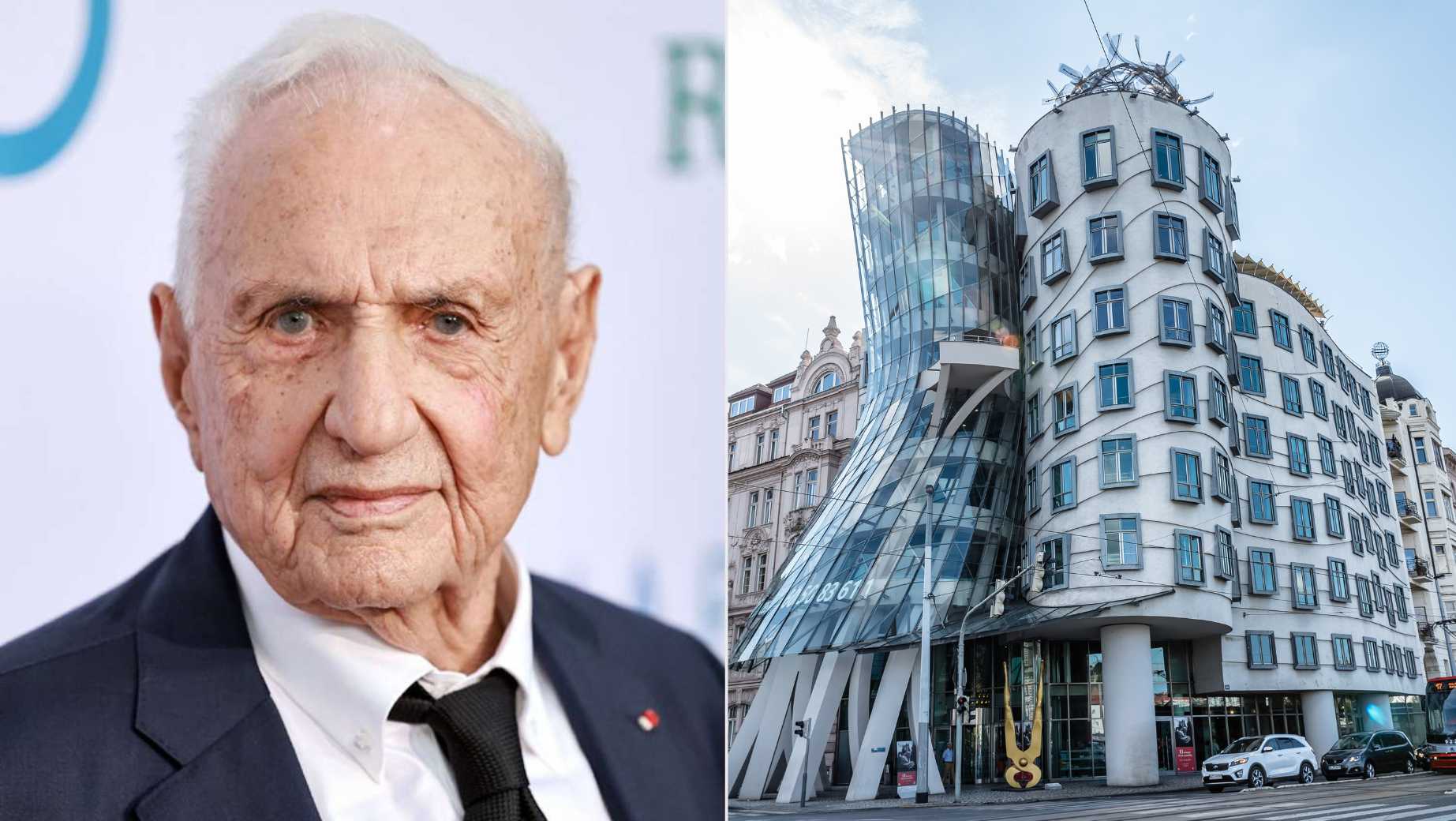

Frank Gehry, the Canadian-American architect whose work reshaped cities across the world, has died at 96. His death was confirmed by longtime colleague Meaghan Lloyd, according to BBC reporting.
Although Gehry became internationally known for projects in North America and Spain, his influence can be seen every day in Prague. The Dancing House, created in the early 1990s together with Croatian-Czech architect Vlad Milunić, remains one of the city’s most recognizable contemporary buildings.
Gehry’s approach to architecture broke away from the traditional language of straight lines and predictable forms. He often turned to steel and other metals, bending and layering them into structures that challenged the eye and the imagination. That vision eventually produced one of his most famous works — the Guggenheim Museum in Bilbao — a building widely credited with transforming the Spanish city’s profile.
By the time he and Milunić began work on the riverfront site in Prague, Gehry had already developed a design philosophy that blurred sculpture and architecture.
Their concept, inspired by the dynamic movement of dancers Ginger Rogers and Fred Astaire, gave Prague a building that contrasted sharply with its surrounding 19th-century facades. The project, completed in 1996, remains a daily reminder of Gehry’s willingness to take risks.
LATEST JOBS IN PRAGUE
His buildings are scattered across continents: the Walt Disney Concert Hall in Los Angeles, the Lou Ruvo Center for Brain Health in Las Vegas, the Museum of Pop Culture in Seattle, and the twisting Gehry Tower in Hanover. Each carries elements of his signature approach but responds differently to its setting.
News of his death has prompted tributes from across the architectural world, where Gehry was often cited as a figure who expanded the possibilities of contemporary design.
Would you like us to write about your business? Find out more
-
NEWSLETTER
 Subscribe for our daily news

Most Popular