Prague Exhibition Center in Holešovice hosts a spectacular exhibition of one of the most famous animation studios, Disney’s PIXAR, since February 15th. Pixar will allow visitors to look at some of the world’s best animators under the hood, uncover the development of popular filmmakers, introduce unique sketches and practices to create a phenomenon over the last 30 years. Enthusiasts who visit the show will see how animated films are made and what goes into bringing the character to life. The exhibition also features a cinema called “Artscape”, where visitors see a special film in which the most famous animated characters meet on one screen. A great attraction is also a special device that allows you to see models of characters right in front of viewers. All this has been unavailable to millions of fans around the world and now Czechs have this unique opportunity. Pixar – 30 Years of Animation is an official travelling exhibition of significant studies. In 1995, the company introduced Toy Story to cinema screens, which was a breakthrough, and thanks to the film it completely rewrote the history of animation. It all started with a small group of enthusiasts, but thirty years of development and work created...
The Czech Parliament has approved a government plan to guarantee the short-term rights of British citizens in the country in the event of a “no-deal” Brexit. The lower house approved the plan in January, and the upper house, or the Senate, followed suit in a 72-1 vote on Wednesday, AP reports. The plan means that the roughly 8,000 Britons currently living in the country would retain their rights immediately after Brexit, even if Britain crashes out of the EU in March with no deal. They would retain basically the same rights as citizens of EU countries for a transitional period until December 31, 2020. “The goal of the law is to prevent serious complications” those Britons might face, Interior Minister Jan Hamacek told lawmakers. Author: red
The annual Pivex Gold Cup competition this year recognized Zubr and Litovel, each winning in two categories. The competition was held in Brno for the 27th time. Zubr was also named best brewery in a special award to mark the competition’s silver jubilee. The Pivex Golden Cup has been organized since 1992. The Zubr brewery is in Přerov in the Olomouc region. Pivex Golden Cup 2019 (Zlatý pohár Pivex) Main winned – Zubr Gold Bright lager – Zubr Grand Light draft (výčepní pivo) – Zubr Gold Dark beer (Tmavá piva) – Bernard černý ležák Nonalcoholic beer (Nealkoholická piva) – Birell Mixed low alcohol and nonalcoholic beers – Holba In the mini-brewery contest, the Merklín crocodile of the Petr Petružálek brewery took first prize. “Zubr again confirmed the quality of its beers that have long been appreciated not only professionals but also consumers,” the brewery said in a press release. The brand name refers to European bison. Author: red
According to the 2019 Bloomberg Healthiest Country Index, six of the ten healthiest countries in the world are in Europe. In first place came Spain, which jumped from sixth in 2017. Spain is also, according to the Institute for Health Metrics and Evaluation, set to have the highest global life expectancy in 2040—showing that the Iberian nation is leading the way in both quality of life and longevity. The pole compared 169 world economies together and was mainly focused on factors such as eating, obesity, tobacco use, and hygiene. The Czech Republic finished in 29th place. Following Spain is Italy—as it turns out, living la dolce vita is good for your mind, body, and soul. The island of Sardinia in Italy, which has almost 10 times more centenarians per capita than the United States, also follows a Mediterranean diet and encourages an active, outdoor lifestyle with its mild climate. In third place is Iceland, Japan came in fourth, the first Asian country to make the list. Rounding out the top ten were: Switzerland, Sweden, Australia, Singapore, Norway, and Israel. The United States ranked 35th. Researchers analyzed data from the World Health Organization and the World Bank, focusing on environmental conditions and access to clean water in addition to the...
Prague City Hall has opened an entrepreneurial and innovation centre on the ground floor of Škoda Palace, with the aim of gathering together in one place all the comprehensive information on promoting business and innovation from the public and private spheres. “Our aim is that Prague becomes perceived abroad as not only a tourist destination but also as an important economic and business centre,” said the city’s mayor Zdeněk Hříb. The centre offers space with modern technology and its staff plan to organize a variety of educational events, provide personal consultations and work with universities and national institutions. The project is designed not only for entrepreneurs and business people but also for students, academics, innovators, researchers, and the general public. In the future, the city council also wants to add an expat centre project expanding its professional consulting services to provide information in English to students, investors, and workers coming to Prague from abroad. “We are working to maximize support for meaningful business projects. We want to reach out to small and medium-size companies, mostly those which have been operational for three years or less. We can offer them up to 85 percent of the cost of implementing quality projects,” said Vít Šimral, a...
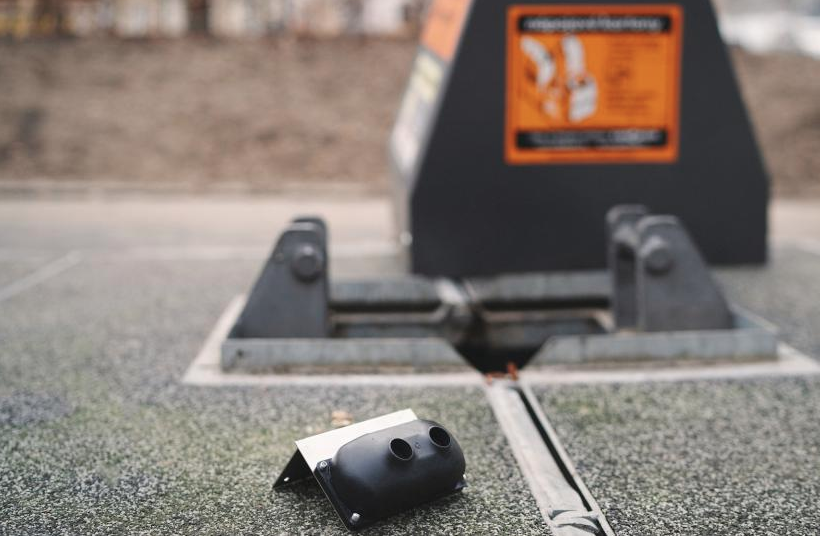
Prague has started the testing of smart containers, reports Rozhlas.cz. So far, the Czech capital has been planning the waste collection on yearly basis with fixed schedules of service for the overall four thousand containers for sorted waste in the city. The ICT operator, thanks to the newly installed about 400 containers, will be able to manage the process much more intelligently. Owing to sensors that are able to report in real time and on a continuous basis the levels of fill of the containers, once the new systems enter fully into operation, it will be possible for the garbage trucks to only stop for those containers, which need to be emptied, thereby reducing travel distance, CO2 emissions and saving energy from transport. And its mechanism is fairly simple. The new sensors will send an ultrasound signal that gives information, which is translated into concrete levels of fulfillment, calculated on the basis of smart data, reports Ondřej Šárovec, project manager for the ICT Operator Pilot Project, to reporter Vojtěch Koval. Moreover, the state of each container could be checked in a dedicated mobile app by drivers, which allows them to plan the optimal route for the specific working day. Author: red
The Founder Institute, the world’s premier idea-stage accelerator and startup launch program, announced today that it is officially launching its newest chapter in Prague. With plans to run two semesters annually, the Founder Institute aims to launch over 20 meaningful and enduring technology companies per year in Prague. Applications to the program are open now, and anyone interested in working with Prague’s top startup mentors to launch a technology company is welcome to apply to the Prague Founder Institute here. In order to celebrate the launch, the Prague Founder Institute will host a series of free startup events for the general public, where attendees can learn how to build a company and learn more about the program. See the full list of events here. The course will celebrate the launch of the first semester with a VIP launch mixer in the rooftop bar in Prague’s own Duplex Nightclub on the 13th of March. “The goal of the Founder Institute is to empower the entrepreneurial talent in Prague’s workforce to build technology companies through our part-time program.” says Adeo Ressi, Founder & CEO of the Founder Institute. “With the expertise of the Local Leader team and our proven, step-by-step curriculum, we...
On Sunday, as part of the new program „Tučňáčí občanky“, visitors to the Prague Zoo can enjoy the 25th birthday of Penguin Humboldt Karlík and the production of “citizens” for selected penguins. Between 10:00 and 15:00 an information stand will be set up at the penguin’s exhibition, where visitors will learn a lot of key facts about their life, threats against their wellbeing and about protection. At 11 am, the penguin feed is commenced. Children will also be able to paint a silhouette of a selected penguin from the Prague Zoo during the entire program. And then at 2 pm, the breeders will explain how they recognize each penguin according to features such as, for example, a dot, and hand over a special cake to Karlik for his 25th birthday. Author: Lilato Madiri Photo: Jana Myslivečková / Zoo Praha
A new study published by Mendel University in Brno revealed that Prague is the most-advanced smart city in the Czech Republic. In 2016, Prague Mayor Adriana Krnáčová (ANO) introduced a series of new projects dedicated to Smart Prague (SP). “Digitization and the Smart Prague project was one of the main priorities for us and it has yielded great results. A city that is driven by data is managed more efficiently and better. For example, we launched the Golemio data platform, which collects and evaluates data. The Smart Town Agenda was directly under the authority of Mayor Krnáčová and it started very well,” says Radomír Nepil, deputy chairman of the ANO movement. Prague Golemio’s data platform is presented as an example of good practice in the analysis. The platform also makes key public data available. (We can now find the so-called real-time data from parkomats and virtual parking hours on Golemio.cz.) Through records of all payment transactions, you can get information about how many cars, where and when the parking space was paid. Prague was among others evaluated in the analysis as the city that is best in complex and systematic work with urban data in the city’s management. The pilot project...
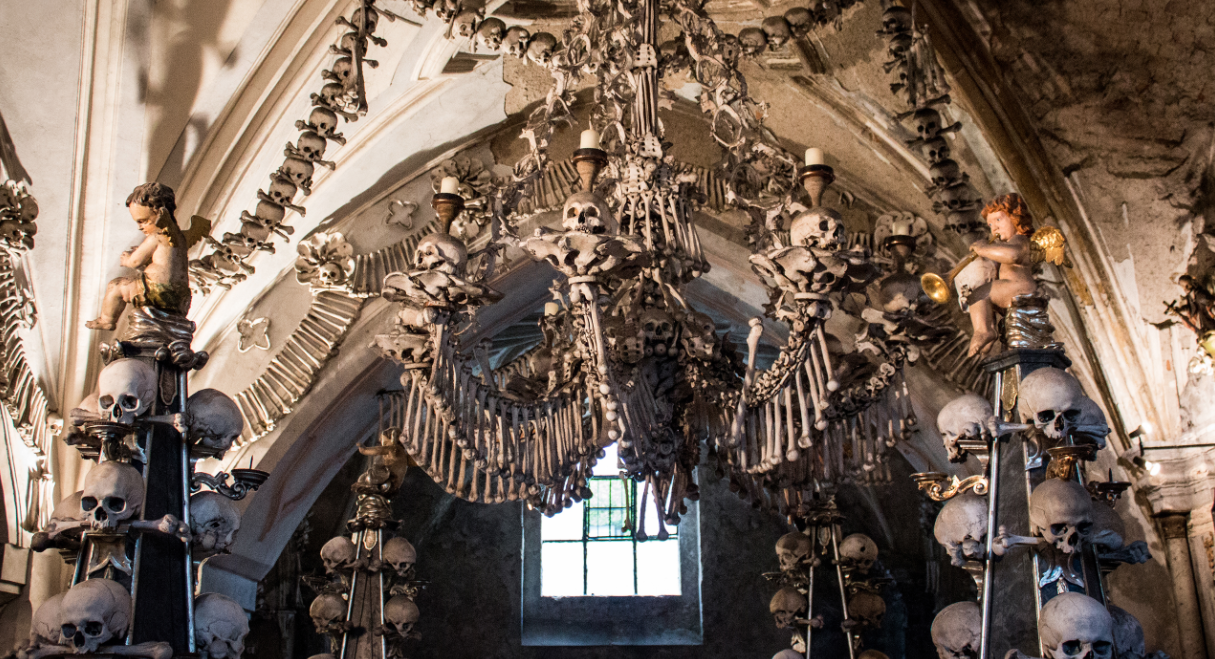
Restoration experts have been set an unusual task – to dismantle four towering pyramids made up of centuries-old bones from more than 40,000 human bodies, clean them up and then reconstruct them as before. The restoration project is aimed at preserving the bones at the Sedlec ossuary church in Kutna Hora. The project also aims to restore and strengthen the church building which houses the bones and skulls. The site also boasts a chandelier, a coat of arms and various other decorations made from every bone in the human body. “Many people find it weird today and come to see this as some dark spectacle, a house of horrors,” said Radka Krejci, in charge of operations at the local parish. “But we do not want it to be perceived like that, it is a place of reverence, a burial place.” The bones came from a cemetery adjacent to a monastery founded by the Cistercian order in 1142. The burial ground was enlarged during a plague epidemic in the 14th century. In 1318, about 30,000 people were buried here and more joined them in the 15th century during religious wars between Roman Catholics and the Hussites. The present appearance of the bone structures dates...
Jerry Agudogo was born in Accra, Ghana. He wanted to be a doctor for a long. So when he got a newspaper with an ad promoting a government scholarship to study in Czechoslovakia in 1984, he did not hesitate. His father was an appraiser and his mother was a midwife at a hospital where he now works. He always wanted to be a doctor. When he was due to go to a medical school in the capital, there was a coup in the country and the school was to be closed. “But there was an opportunity to apply for a scholarship,” he recalls in perfect Slovak. It was written in 1984 and he was given the opportunity to study newspapers in Czechoslovakia. From his own inquisition he knew about Charles University in Prague, so he was very pleased to go to Prague, only to discover at the airport in Ruzyne that he was going to study in Slovakia. First, he underwent a nine-month language course in the Slovak town of Senec, along with a number of other foreign students. In the medicine circle in Bratislava, he was the only foreigner, who studied in Slovak and the textbooks were often in...
This past week we were already enjoying the spring weather coming slowly, but winter weather is due to return to the Czech Republic. The fall of temperatures will be caused by a weak cold front, which will pass over the Czech Republic overnight and bring with it not only cooler temperatures but also more cloudy skies. In some places, it can even snow again. The cold is gradually making its way back to the Czech Republic, with typical February weather. Even today, cloudiness is beginning to come from the west, which will not be precipitated for the time being. There will be a lot of clouds around mid-morning, the temperatures will be around 0, afternoon around 7 degrees above zero. On Thursday, the entire area will be overcast, meteorologists expect rain that will fall thousands of meters above the sea level to pass and even mixed with snowfall. Afternoon temperatures will be about seven degrees above zero. On Friday, it will begin to clear again, during Saturday and Sunday, the highest afternoon temperatures should climb to a pleasant 11 degrees, on Monday even reaching 12. Author: Lilato Madiri
Don’t have an account? Register
Already have an account? Log In
How Would You Like to Promote Your Business? PR ArticleDisplay bannersVideo productionNewsletter adsJob ListingsInfluencer Marketing
Your Email
We will come back to you within 24 hours with our proporsal