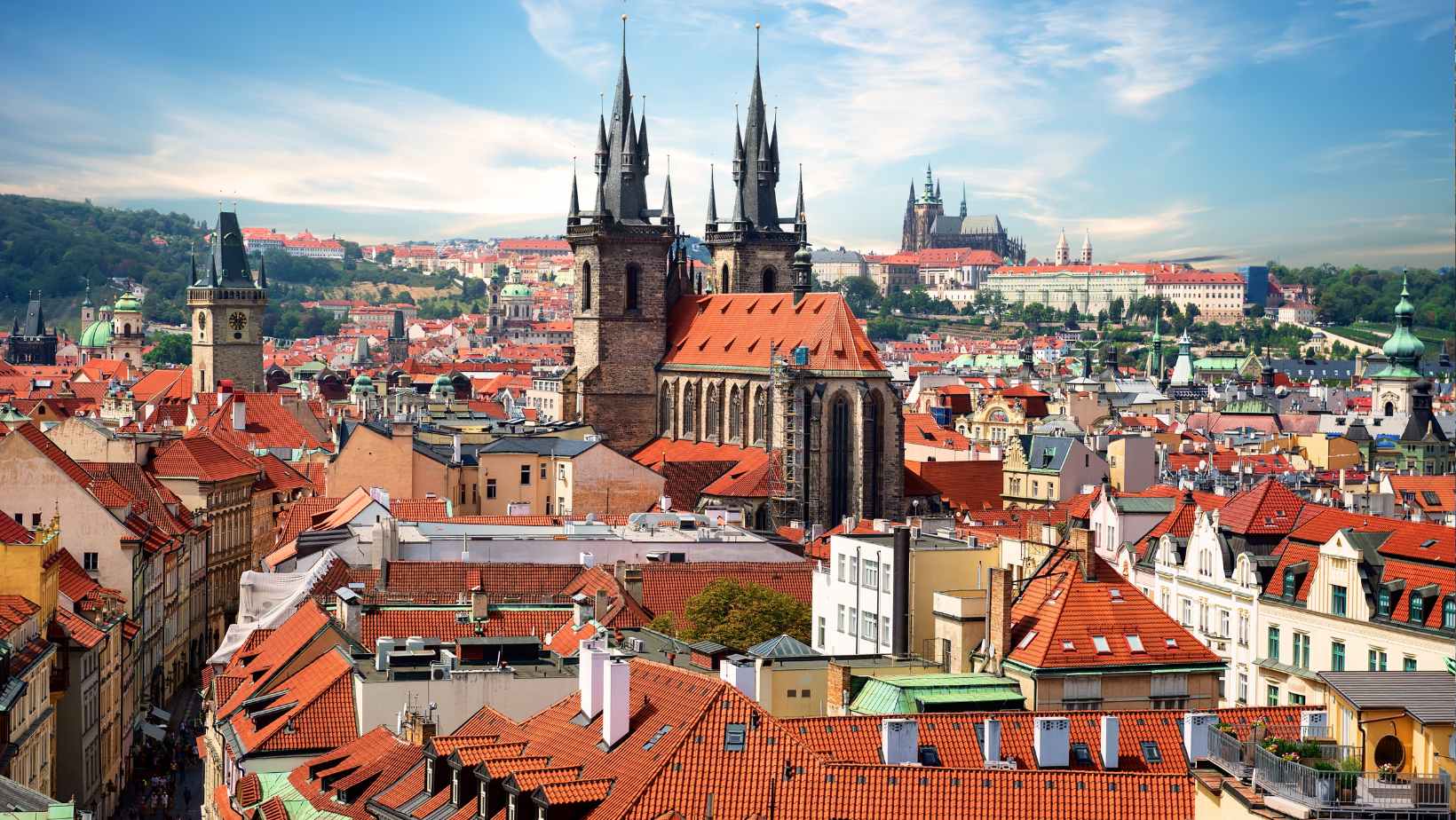
What will Prague’s transport look like in 2050? An ongoing exhibition at the Centre for Architecture and Metropolitan Planning (CAMP) offers a look ahead. Prague Tomorrow? Connected City, running until 26 October 2025, presents a bold vision of how rail transport could reshape life in the Czech capital—and beyond. The exhibition, which opened in March, shows how rail is undergoing a renaissance around the world. Prague is no exception. Plans are in motion for dozens of new lines and tunnels that will redefine how people travel across the city and connect Prague to the rest of the country and Europe. “Passenger rail transport is on the rise and plays an increasingly important role in suburban and long-distance transport. More than half a million new inhabitants are expected in Prague and Central Bohemia over the next few decades. All of them will need to get to work, school, or travel—and our new rail links must be ready,” says Transport Minister Martin Kupka. High-speed rail will connect Prague with Dresden, Wroclaw, and Vienna, with trains reaching speeds of up to 320 km/h. The trip from Ústí nad Labem to Prague Main Station is expected to take just 26 minutes. Metro Line D,...
After a hot start to the week, Czechia is bracing for a shift in weather. A cold front will sweep across the country, bringing showers, thunderstorms, and a drop in temperatures — especially by Thursday, when highs may not exceed 17 °C in some regions. The Czech Hydrometeorological Institute (ČHMÚ) has issued a weather warning for high temperatures in southeastern Moravia, where the mercury is expected to climb to 32 °C on Monday afternoon. Elsewhere, highs will range from 26 to 30 °C, but unstable air will trigger afternoon storms, particularly in southwestern and western Bohemia. The cooling trend will continue into Tuesday, with skies remaining mostly cloudy to overcast. Occasional showers and thunderstorms are expected, especially later in the day. While the eastern and central regions may still reach 25 to 30 °C, western and northwestern areas will struggle to exceed 22 °C. Wednesday will bring widespread cloud cover, with more showers and isolated thunderstorms across most of Czechia. Temperatures will range from 20 to 25 °C, indicating a steady decline as the cold front tightens its grip. By Thursday, the weather will reach its coldest point of the week. Highs will drop to 17 to 22 °C, with...
The future of the Stalin Cultural Center, located beneath Prague’s Metronome in Letná Park, appears more hopeful after recent talks between the center’s operator and city representatives. While previous reports signaled its closure due to a lapsed permit, a temporary outdoor-only operation is now on the table. The venue hosts concerts, screenings, and community events. Yet over the past few weeks, the team behind the center announced that its continued existence was in jeopardy. The reason? A dispute over the unapproved use of underground spaces. According to Adam Zábranský (Pirates), Prague city councilor, the original permit did not allow the storage of equipment in the underground areas beneath the Metronome, yet these spaces were being used as warehouses. That violation led to the city declining to extend the lease. Center operator Jan Foltys confirmed that negotiations are underway and cautiously optimistic. “Nothing is certain until the contract is signed, but there’s a chance we could save part of this season with a provisional outdoor setup,” he said. For now, the team behind the center is doing what they can to keep things running — at least the basics. That means keeping the toilets open and making sure the area stays...
One day after the documentary Raději zešílet v divočině (Better Go Mad in the Wild) won the Grand Prix at the Karlovy Vary International Film Festival, one of its main subjects, František Klišík, was found dead near Prague. He was 62 years old. According to Metro.cz, Klišík drowned in a pond in the village of Ohrobec in the early hours of Sunday. Around 8:30 a.m., a local resident noticed an unresponsive man in the water. Emergency services and a coroner were called to the scene. “There were no signs of foul play,” said police spokesperson Michaela Richterová, adding that the exact cause of death will be determined by an autopsy. Klišík had reportedly been in Ohrobec to visit a friend and celebrate the film’s success. Witnesses said he was in a positive mood, though it wasn’t clear where he planned to spend the night. The pond is located across from the village pub. The documentary, directed by Miro Remo, follows the life of František and his twin brother Ondřej, who spent decades living off the grid in Stögrova Huť, a remote settlement in the Šumava region. The film is based on a book by Aleš Palán, who confirmed Klišík’s death...
The 59th Karlovy Vary International Film Festival wrapped up on July 12 after screening 108 features, 23 documentaries, and 44 shorts across 465 showings. With more than 128,000 tickets sold, the Czech festival once again cemented its place on the global film calendar, just after Cannes and ahead of Venice. The festival’s top honor, the Crystal Globe, went to “Better Go Mad in the Wild”, directed by Miro Remo (Czech Republic/Slovak Republic). The film’s team received a $25,000 prize. Iran’s “Bidad”, by Soheil Beiraghi, won the Special Jury Prize and $15,000. Jurors praised its bold narrative and genre-blending story of a couple on the run through Tehran, describing it as “shot through with punk energy” and closing on a hopeful note. The Best Director awards were shared between Vytautas Katkus for “The Visitor” (Lithuania, Norway, Sweden) and Nathan Ambrosioni for “Out of Love” (France). Acting awards went to Pia Tjelta for her performance in Norway’s “Don’t Call Me Mama”, and Àlex Brendemühl in Spain’s “When a River Becomes the Sea.” Kateřina Falbrová earned a Special Jury Mention for her role in “Broken Voices” (Czech Republic/Slovak Republic). The audience-favorite Právo Award went to the Czech documentary “We’ve Got to Frame It!”,...
Petr Kotík, the founder of the popular travel site Amazing Places, is launching a new project: Kouzelné Chaloupky (which means Magical Cottages) – a booking platform dedicated entirely to private getaways like cottages, log cabins, glamping spots, and tiny houses. Unlike Amazing Places, which is known for high-end design retreats, Kouzelné Chaloupky focuses on cozy, affordable escapes that prioritize privacy and simplicity over luxury. The platform features only independent, non-shared accommodations, such as standalone cabins and off-grid cottages – no hotels or guesthouses. “Czech cottage culture is a lifestyle – it’s about slowing down, spending time together, and feeling at home even far from home,” said Petr Kotík, who leads the project. “We want to make this experience more accessible to everyone.” The project grew out of a social media community that already counts 160,000 followers, and it’s now evolving into a full-featured booking site. The platform enables users to book directly, use vouchers, and take advantage of the BeAmazing loyalty program. Each listed property goes through a basic screening to ensure quality standards. There’s no need to share spaces with strangers – every stay guarantees complete privacy. Kouzelné Chaloupky also offers benefits for hosts. Accommodation providers can access the...
The Czech Republic is reviving its push to protect traditional meat product names—this time, across the European Union. Agriculture Minister Marek Výborný (KDU-ČSL) has submitted a proposal supported by 18 EU member states, calling on the European Commission to restrict plant-based producers from using terms like “vegan sausage” or “soy schnitzel.” The move echoes existing rules around dairy alternatives, where terms like “milk” or “yogurt” are reserved exclusively for animal-based products. Supporters argue that consumers can be misled by familiar meat-related terms used on plant-based packaging. Critics, however, say the proposal reflects pressure from industrial meat lobbies—not a genuine concern for transparency. At a June meeting of EU agriculture ministers in Luxembourg, Deputy Minister Miroslav Skřivánek claimed such a policy would “protect consumers from misleading information” and reduce fragmented food labeling rules across Europe. Backing the Czech initiative are heavyweights France and Italy, as well as Ireland, Austria, Portugal, and Spain. In contrast, domestic reaction has been mixed. Just one week after the proposal was introduced, a coalition of Czech food producers, retailers, and associations issued an open letter urging Výborný to withdraw the proposal. Signatories included Globus, Rohlik.cz, the Czech Trade and Tourism Association, and the Association of Hotels...
The historic town centre with its numerous churches, all surrounded by medieval city walls, has preserved its Renaissance look and is full of crooked lanes, romantic views and picturesque nooks and crannies. Znojmo is a quiet town in South Moravia that doesn’t get nearly enough attention. It sits near the border with Austria and Slovakia, in a region famous for its vineyards and traditional food. Locals sometimes call it “Moravian Tuscany” because of its rolling hills and charming villages. Last year, South Moravia welcomed just over 690,000 tourists from abroad. That’s a fraction of the millions who visit Prague, which means places like Znojmo stay peaceful and less crowded. Founded around 1226 by King Ottokar I, the town has about 34,000 residents and is just a two-and-a-half-hour drive from the capital. One big draw here is the price. Four-star hotels often charge less than 1,500 CZK per night, and most sights are easy on the wallet. For example, you can explore the town’s famous tunnels for about 100 CZK. These tunnels, carved in the 14th century, run under Znojmo and stretch for 27 kilometers. They were originally built as shelters during times of war and later used for storage. Over...
New data from Eurostat reveals that the average Czech employee works 37.8 hours per week — nearly four hours more than workers in Germany or Austria. Over the course of a year, that adds up to 200 extra hours, or five additional full working weeks. Yet despite the longer hours, Czech wages remain far lower than those in neighboring countries. “Over a lifetime, a Czech worker puts in several more years of labor compared to someone in Germany,” said Jiří Vaňásek, Vice-Chair of the Czech-Moravian Confederation of Trade Unions. In fact, when those weekly differences are accumulated across a working life, the gap becomes hard to ignore: Czechs can expect to work around four years longer than Germans — and some union estimates suggest the gap may be even wider due to older baseline data and changing trends in working hours. Long Hours, Low Wages The average Czech working life spans about 38 years, though this can vary based on education. And the compensation doesn’t match the time invested. A 2024 report from Mazars shows the average private-sector monthly wage in the Czech Republic was CZK 46,557, compared to CZK 116,682 in Germany and CZK 126,125 in Austria (converted from...
A Czech tourist died on Friday afternoon in the Italian Dolomites after falling from a mountain trail, Italian news agency ANSA and public broadcaster RAI reported. The man had reportedly strayed from his group during a hike and lost his footing. The accident occurred around 2:00 p.m. in the Val di Fassa area of the Trentino region, a popular destination for mountain hiking and climbing. The man, who was about 50 years old, had been hiking with others toward Passo San Nicolò, a mountain pass located at roughly 2,400 meters above sea level. According to early reports, the man accidentally left the designated trail, lost his balance, and fell onto rocks below. Members of the hiking group immediately alerted mountain rescue services, and a rescue helicopter was dispatched to the scene. However, despite swift intervention, the man succumbed to his injuries at the site. His body was later transported down to the valley by emergency crews. The Czech Ministry of Foreign Affairs has not yet confirmed the details, but Czech media report that officials are currently reviewing the case. Would you like us to write about your business? Find out more
Bulgaria is set to join the eurozone in January 2026, after meeting all the necessary criteria. The European Commission, European Central Bank, and EU finance ministers confirmed the country’s readiness in June. Bulgaria’s currency, the lev, has been pegged to the euro since 1999, so this move finalizes its long-standing monetary policy approach and gives the country full voting rights within the ECB Governing Council. However, public opinion in Bulgaria remains divided. Nearly half of the population opposes the euro, mainly due to concerns over price increases — similar to what Croatia experienced after switching to the euro in 2023 — and fears about losing national control over economic decisions. Czechia Maintains the Koruna – But Moves Closer to the Euro in Practice Unlike Bulgaria, the Czech Republic has taken no concrete steps toward joining the eurozone, despite being formally committed to adoption since entering the EU. Along with Poland, Hungary, Romania, and Sweden, Czechia has delayed entry indefinitely, citing political and economic concerns. Support for adopting the euro remains consistently low. In 2024, just 20% of Czechs supported euro adoption, while 80% were opposed. Around half of those were strongly against it. The main reasons include fear of rising...
The pedestrian underpass beneath Legerova Street, once a key shortcut for thousands of pedestrians moving between Wenceslas Square and Vinohrady, is being dismantled. Its demolition marks the next phase in the construction of the long-planned Museum tram line, which will eventually link central Prague more efficiently. This tunnel, located just a few steps from the National Museum, is disappearing from the city’s map after decades of use. The change reflects Prague’s effort to expand its tram network and improve surface transport around the Museum and main station area. Demolition began as part of extensive works that have been underway for several weeks. Crews are currently focusing on the stretch adjacent to the National Museum building, aiming to integrate the new line with the section that will run through Vinohrady. Although the tracks between the old and new National Museum buildings were laid as early as 2018, they remained unused. That 80-meter segment stood isolated, waiting for the rest of the line to catch up. Now, that wait is over. If construction proceeds on schedule, the new tram route should be operational by mid-2027. City officials say the new line will dramatically change the way people navigate the area. “The new...
Don’t have an account? Register
[swpm_registration_form level=”6″]
Already have an account? Log In
How Would You Like to Promote Your Business? PR ArticleDisplay bannersVideo productionNewsletter adsJob ListingsInfluencer Marketing
Your Email
We will come back to you within 24 hours with our proporsal