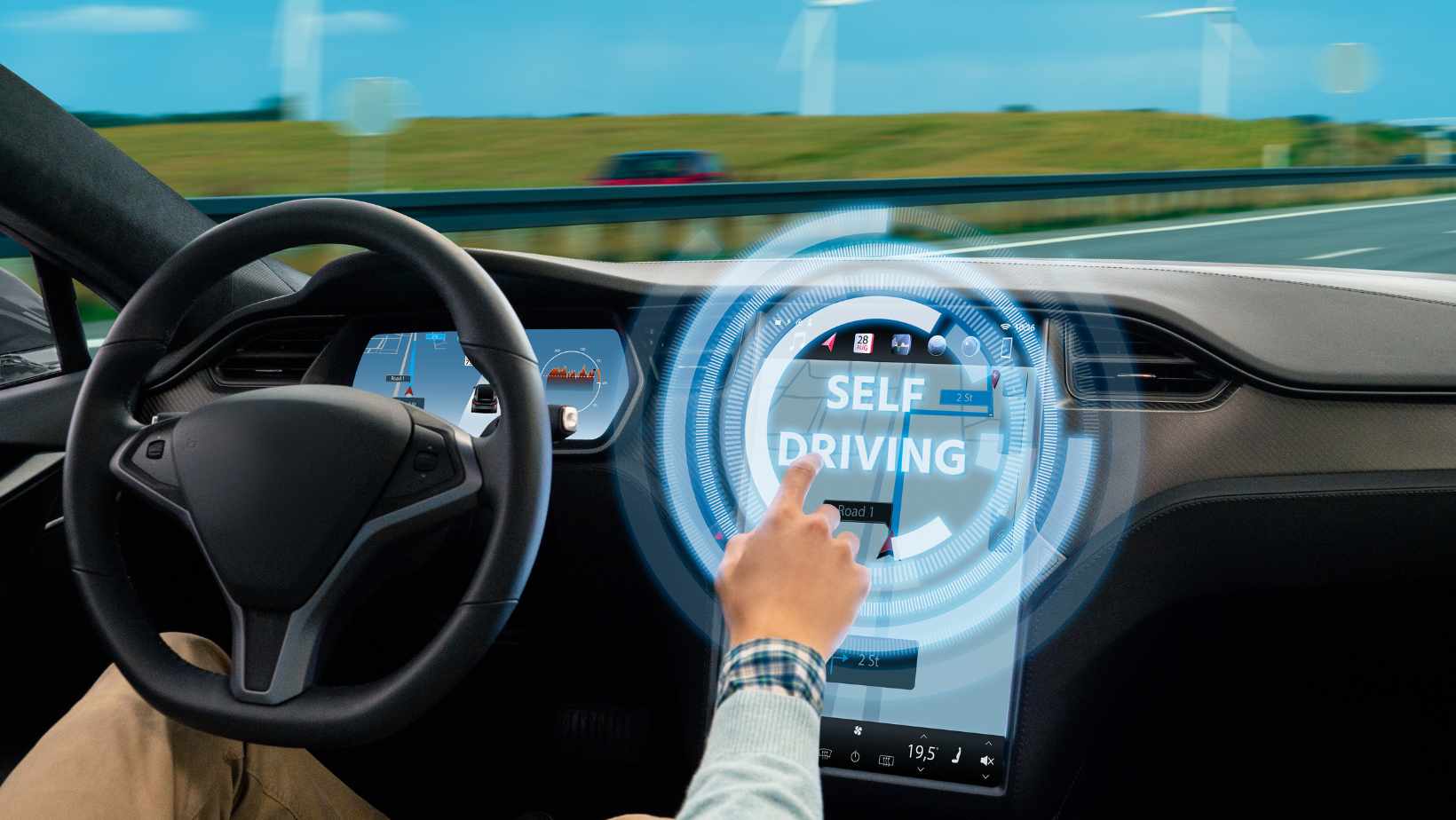

The Czech Republic is preparing the legal and technical framework for fully autonomous vehicles.
For now, however, cars without drivers are not allowed on Czech roads.
At the moment, only limited semi-autonomous driving is permitted, and only on selected highway sections.
Since the beginning of this year, vehicles equipped with advanced systems have been allowed to operate in what is known as Level 3 automation. In these cases, the driver may temporarily hand over control, but must be ready to intervene immediately if conditions change.
According to the Ministry of Transport, no fully self-driving cars are currently registered in the country.
These semi-autonomous systems can function only on clearly defined stretches of highway, where traffic flows in separate lanes and pedestrians and cyclists are prohibited. The vehicle must also confirm that all onboard systems are operational.
Weather conditions play a decisive role. Reduced visibility caused by fog, heavy rain or snowfall automatically disqualifies the use of automated mode.
When the car detects that it has entered an approved section and that conditions meet the criteria, it alerts the driver that autonomous driving is available. If the situation changes — for example due to deteriorating weather or road conditions — the system prompts the driver to retake control.
Under international standards, autonomous driving is divided into five levels. The Czech Republic currently permits only the third level. Moving to higher levels, in which the vehicle can operate entirely without human intervention, will require not only technological progress but also new infrastructure.
The Ministry of Transport is preparing the legal and technical framework for that shift. A central requirement is enabling vehicles to communicate with each other and with surrounding infrastructure in real time. That demands a stable, high-speed data connection.
The state plans to expand 5G network coverage by 2030 to support this goal, in cooperation with the Ministry of Industry and Trade and the Czech Telecommunications Office. The overall cost of the transition has not yet been calculated.
Another key component is the modernization of digital mapping systems.
Three-dimensional maps allow vehicles to interpret their surroundings with precision. They include data points such as the position of street lamps, the height of curbs, the location of trolley lines, bus stops and traffic signs.
If the country moves to Level 4 automation, the role of the human driver would change fundamentally. At this stage, a person would no longer need to sit behind the wheel. However, remote supervision would remain necessary in certain situations.
Remote operation could also apply to buses and taxis. The Ministry of Transport has not set a timeline for introducing Level 4 automation.
Would you like us to write about your business? Find out more
-
NEWSLETTER
 Subscribe for our daily news

Most Popular