

By Staff Correspondent
In today’s hyperconnected digital world, cyber threats have become a constant, invisible war zone. From phishing schemes to state-sponsored attacks, the battleground is everywhere, and the stakes are higher than ever.
Leading the charge toward a safer digital future is Md Imran Khan, a cybersecurity researcher and engineer whose pioneering work on “Proactive Cyber Threat Detection Using Artificial Intelligence (AI) and Open-Source Intelligence (OSINT)” is transforming how organizations in the United States defend their digital assets.
Transforming Cyber Defense from Reactive to Proactive
Traditional cybersecurity strategies often respond after a breach has occurred. Khan’s work aims to change that entirely. By combining AI-driven predictive analytics with OSINT, he’s developing frameworks that allow businesses and government agencies to detect emerging threats long before they strike.
“Reactive defense is no longer enough,” Khan explains. “Today’s cyber attackers evolve daily. Our defense systems must not just respond they must anticipate.”
Through the integration of advanced machine learning models, Khan’s approach allows systems to automatically analyze millions of data points from open sources including public forums, social media, dark web channels, and threat intelligence feeds to identify early warning signs of cybercrime activity.
This proactive detection model is already helping U.S. enterprises save millions in potential damages by stopping breaches before they begin.
AI and OSINT: A New Alliance in Cybersecurity
At the heart of Khan’s research lies the fusion of artificial intelligence and open-source intelligence. AI provides computational muscle processing vast datasets at lightning speed while OSINT delivers the context, gathering critical information from publicly available digital ecosystems.
When combined, the result is a predictive cyber defense engine that learns continuously. For example, Khan’s framework uses natural language processing (NLP) to detect malicious intent hidden within online communications and neural network classifiers to distinguish real threats from false alarms.
This dual-layer model is now being explored by several U.S. tech firms and cybersecurity startups as a blueprint for next-generation threat intelligence platforms.
Impact on the U.S. Tech Market and Society
Khan’s contributions extend well beyond research labs and server rooms they are influencing how the U.S. technology sector approaches cybersecurity at scale.
Strengthening Business Resilience
His AI-driven detection systems help U.S. companies reduce incident response times by up to 60%, minimizing financial and reputational losses during cyber incidents.
Empowering the Workforce
By automating repetitive monitoring tasks, Khan’s framework free cybersecurity professionals focus on strategic threat analysis and creative problem-solving, a crucial advantage in a market facing a shortage of skilled experts.
Enhancing National Security
The integration of OSINT into cybersecurity models supports public-private collaboration against critical infrastructure threats. This has direct implications for sectors like energy, healthcare, and finance the backbone of the American economy.
Driving Innovation in AI Ethics and Transparency
Khan also advocates for ethical AI use, emphasizing transparency and data privacy in machine learning–based security systems.
“AI must protect without infringing on rights,” he says. “That balance is key to public trust.”
Through these initiatives, Khan is not only advancing cybersecurity innovation he’s contributing to America’s broader digital resilience and economic stability.
Educational Foundation and Research Vision
Khan’s path from Satkhira, Bangladesh, to becoming a recognized cybersecurity innovator in the United States reflects his unwavering commitment to education, research, and global collaboration.
He began his academic journey at the Czech University of Life Sciences, Prague, where his early research and master’s thesis laid the foundation for his ongoing exploration into cybersecurity and data-driven intelligence. His passion for understanding the intersection of artificial intelligence, data science, and network defense was nurtured in Europe — a journey that later expanded in the United States.
His recent IEEE publication, “Evaluating the Effectiveness of Artificial Intelligence in Mitigating Cyber Security Threat Business Environments,” further expands his research scope, offering insights into how AI-driven systems can enhance threat mitigation across complex business ecosystems.
His ongoing projects continue to explore how AI models can autonomously interpret open-source data streams identifying threat actors, tracing attack patterns, and predicting vulnerabilities before they are exploited.
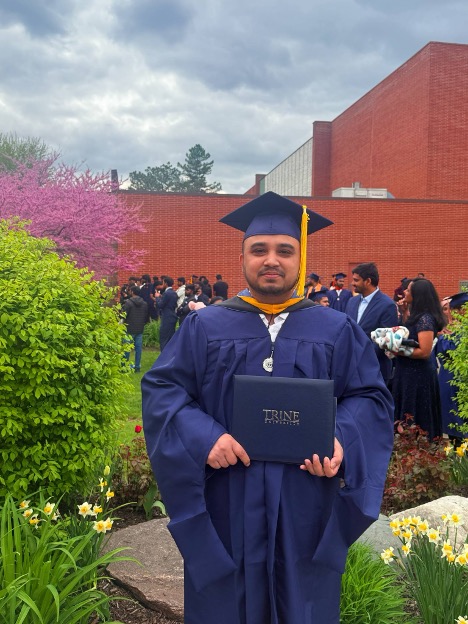
Photo curtesy: Md Imran Khan commencement -2025 at Trine University
A Vision for the Future of Cyber Defense
Looking ahead, Khan envisions a future where AI and human intelligence coexist symbiotically where every organization, from small businesses to national agencies, can access predictive defense capabilities once reserved for top-tier intelligence units.
“Cybersecurity is no longer just about protecting data,” Khan says. “It’s about protecting innovation, privacy, and the trust that powers our digital society.”
His message resonates strongly across the U.S. tech market one that increasingly depends on proactive, AI-driven security to fuel growth, protect innovation, and maintain public confidence in an ever-expanding digital economy.
Md Imran Khan, Author, Researcher
Master of Science in information studies
Trine university, USA
Email: [email protected]
-
NEWSLETTER
 Subscribe for our daily news