

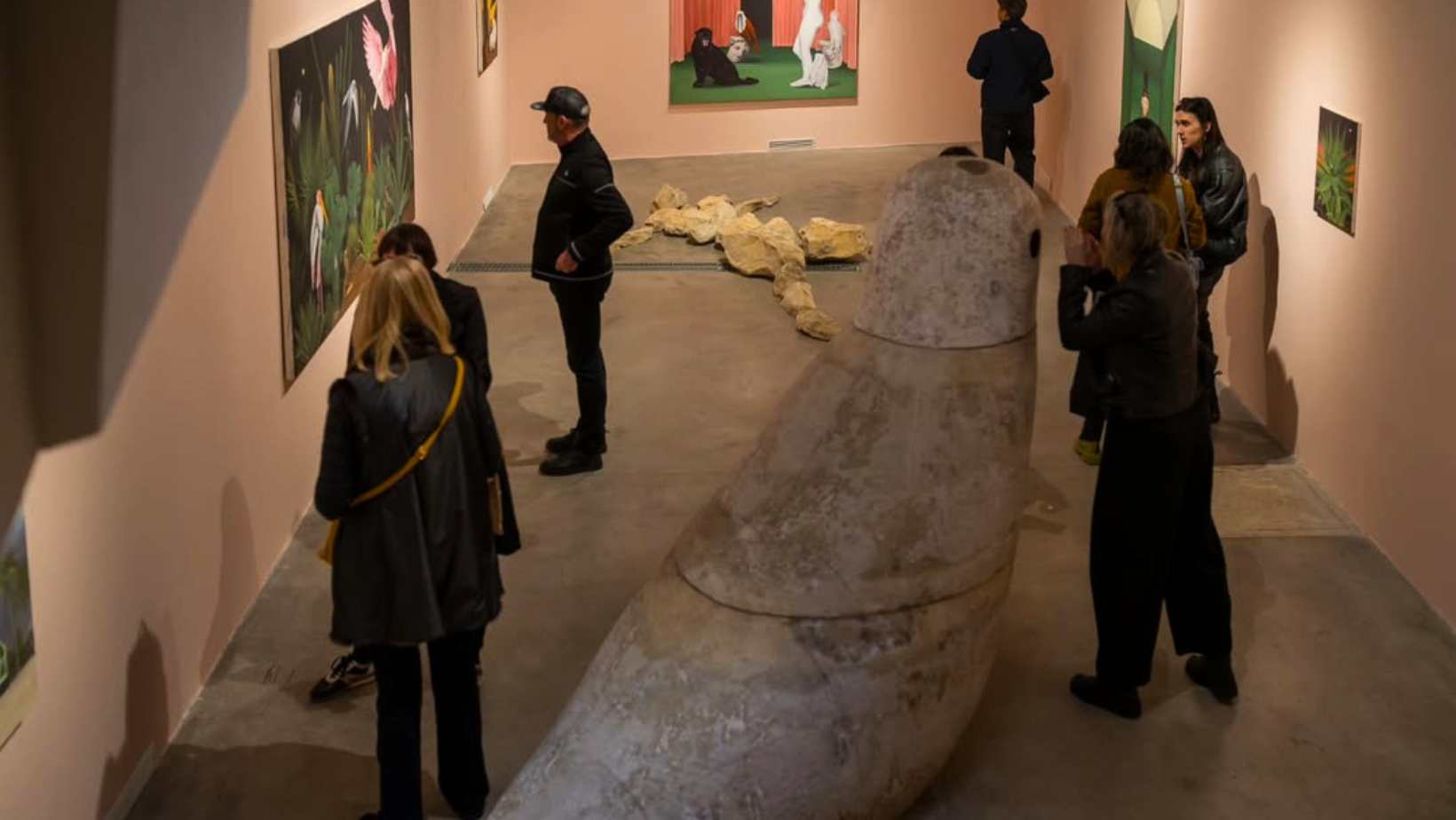

At Karpuchina Gallery, a new exhibition titled After the Atlas brings together two artists who, at first glance, seem to have little in common.
Czech sculptor and painter Kurt Gebauer, now in his 80s, is shown alongside Berlin-based South Korean artist Jina Park, who is in her 40s. The result is a pairing shaped less by similarity than by contrast.
Park describes the exhibition as a meeting point between different worlds. The gap between the artists is not only generational but also rooted in entirely different cultural and historical experiences. Yet it is precisely this distance that gives the show its tension.
Her own work reflects a background that moves between traditions. Trained in Korea before continuing her studies in Germany, Park does not deliberately merge Eastern and Western techniques. Instead, the two influences sit side by side, emerging naturally through her process. Elements of traditional Korean painting appear alongside references to European egg tempera, not as a direct fusion, but as parallel approaches that echo each other.
View this post on Instagram
Several of her paintings focus on birds, rendered in vivid detail. At first, they appear almost hyperreal. On closer look, however, their poses feel slightly artificial, even staged. The images are based on photographs where animals were arranged as objects, pointing to older traditions of display that often framed “exotic” subjects through a colonial lens. By reworking these images, Park quietly questions how such representations were constructed.
The idea to bring Park together with Gebauer did not come from the artists themselves, but from curator Michal Stolarik. According to gallery director Alexandra Karpukhina, the intention was to avoid an obvious pairing. Instead, the exhibition looks for connections that only become visible over time.
Gebauer’s work, shaped by decades of experience in the Czech Republic, reflects on the political and social shifts following the fall of communism. His sculptures and paintings often deal with transformation, breaking down familiar forms and reassembling them in unexpected ways. Park approaches similar ideas from a different angle, placing familiar objects into new contexts where their meaning begins to shift.
Seen together, the works suggest that periods of disruption—whether political or cultural—can open space for new ways of thinking and seeing.
The exhibition also marks the presentation of a new body of work by Park, developed over the past year specifically for this show. Her paintings stand out for their precision and intensity, drawing viewers in before revealing the subtle tension beneath the surface.
After the Atlas runs until May 25, 2026, at Karpuchina Gallery, Rybná 22, Prague 1. The gallery is open from Tuesday to Sunday, 1 pm to 6 pm.
Would you like us to write about your business? Find out more
-
NEWSLETTER
 Subscribe for our daily news

Most Popular