Sinatra Tribute Pairs Frank Sinatra Classics With 1930s Dining at Prague's Mánes
Partner article


Prague Morning
 Follow us on Google Discover
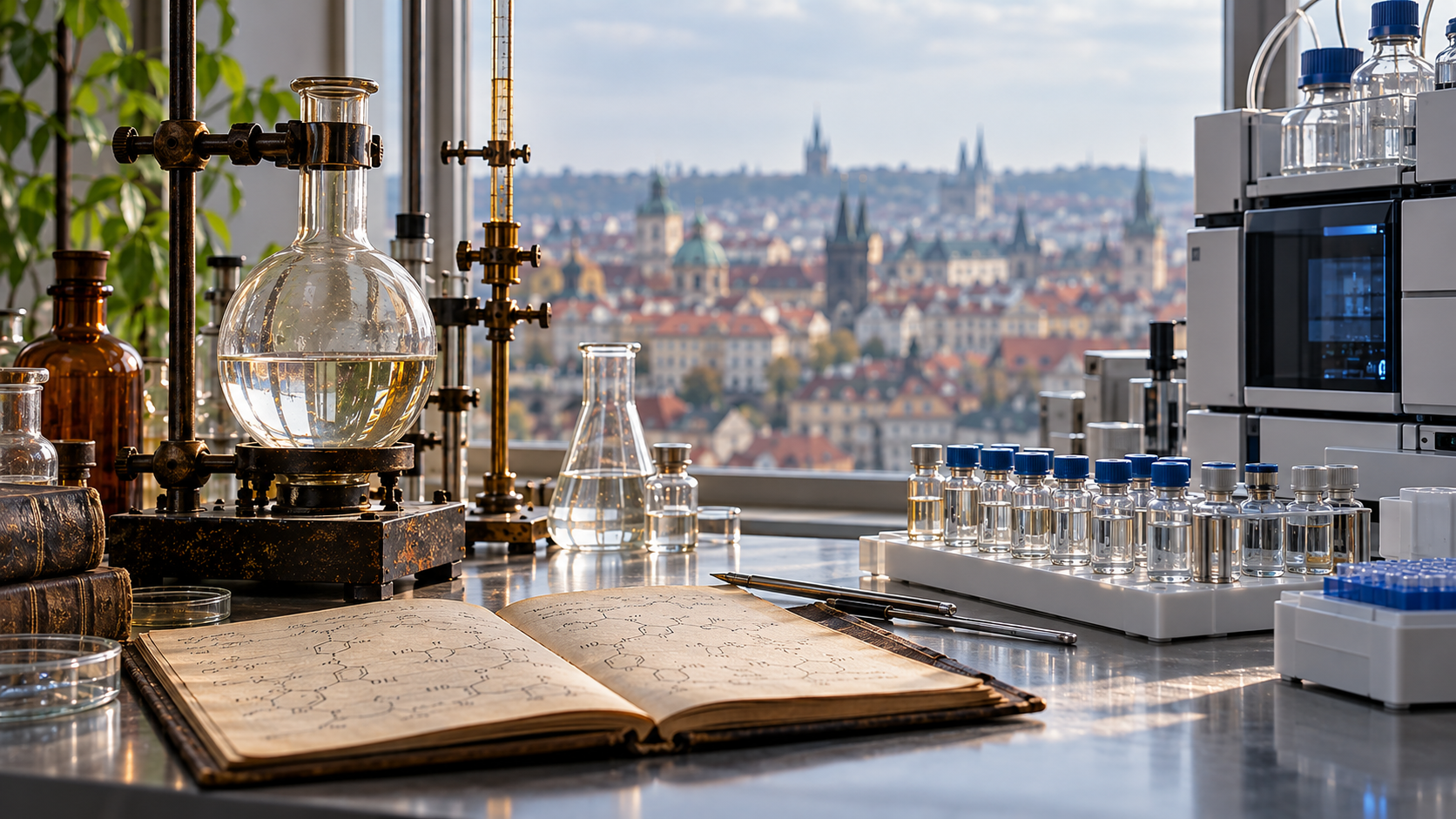

Prague has a quiet but real place in the history of peptide chemistry.
From the 1950s, chemists at what is now the Institute of Organic Chemistry and Biochemistry (IOCB) worked out how to build and redesign pituitary peptides, the city hosted the first European Peptide Symposium in 1958, and one of the institute’s analogues was licensed abroad and produced industrially. The same research base now underpins Prague’s new biotech cluster.
In 1953 Vincent du Vigneaud’s group in New York published a short paper in the Journal of the American Chemical Society reporting that they had made oxytocin in the laboratory. Oxytocin is a peptide, a chain of just nine amino acids, but nobody had synthesised a peptide hormone before, and two years later the work brought du Vigneaud the Nobel Prize in Chemistry.
Making even a chain that short was slow and fiddly. Amino acids have more than one reactive group, so a chemist had to block all the groups that should stay out of the reaction, join two units, unblock exactly one end and repeat the whole cycle for the next amino acid. Every step lost some material. What du Vigneaud’s paper showed was that it could be done, and that a peptide whose sequence was known could be rebuilt and, in principle, rebuilt differently.
That same year, Prague got its own institute for the job. The Institute of Organic Chemistry, renamed the Institute of Organic Chemistry and Biochemistry in 1960, was formally founded in 1953 under František Šorm, who ran it until 1970. Šorm listed peptides and proteins among the handful of subjects the institute would build its research around.
By 1958 the Prague group was established enough to host the first European Peptide Symposium. It took place in September of that year, and the IOCB chemist Josef Rudinger edited the proceedings, which the Czechoslovak Academy of Sciences published in 1960. The symposium has been held regularly since and is now run by the European Peptide Society.
The institute’s peptide chemists spent the next three decades on what is called structure–activity work. The idea is simple to describe and laborious to carry out: take a natural peptide, change one feature, measure how its biological activity shifts and let that result decide the next change. Their material was the family of hormones from the posterior pituitary, the group that oxytocin belongs to, along with its close relative vasopressin. In 1960 they synthesised lysine-vasopressin, a natural form of the hormone found in pigs, and later derived terlipressin from it.
The best-known result came from Milan Zaoral’s team in the early 1960s. Working from vasopressin, they replaced the arginine at position 8 with D-arginine, its mirror-image form, and removed the amino group at the very beginning of the chain. Drawn on paper, the new molecule looks almost identical to the old one. Biologically it behaved very differently: of the two main activities the natural hormone has, the analogue kept one at full strength and lost most of the other. They named it desmopressin.
In the late 1960s the Czechoslovak Academy of Sciences licensed desmopressin to the Swedish company Ferring AB, and by the early 1970s it was being made on an industrial scale in both Czechoslovakia and Sweden. For a structure–activity programme, it was about as clear a demonstration as one could ask for that two small, deliberate edits can change what a peptide does.
While Zaoral’s group was redesigning vasopressin, Bruce Merrifield at the Rockefeller Institute in New York changed the way peptides were made. His 1963 paper described fixing the first amino acid of a chain to a small resin bead. The chain then grew while attached to the bead, and instead of purifying the product after every coupling, the chemist simply washed the excess reagents away.
Solid-phase synthesis, as it became known, was repetitive enough to automate, and Merrifield received the 1984 Nobel Prize in Chemistry for it. It is still the standard method for producing peptides for research, which is why a sequence that once took a team months can now be ordered from a catalogue.
That availability turned peptides into ordinary laboratory tools. Immunologists use short synthetic sequences to pinpoint which part of a protein an antibody recognises. Biochemists use them as substrates when they measure enzyme activity, receptor researchers use them to study binding, and analytical chemists rely on them as reference materials when they develop methods such as mass spectrometry.
The weak point is the material itself. A coupling step that does not quite finish leaves chains one amino acid short, a protecting group can survive to the end, and some of these by-products are hard to tell apart from the intended peptide. Researchers at Ghent University found this out directly when they tested a set of synthetic peptides bought for their own research with a requested purity of at least 95%. Only about 44% met that figure under their analysis, and in one sample the main compound was not the structure that had been ordered.
Problems like that contribute to a wider issue in experimental science. In a 2016 Nature survey of 1,576 researchers, more than 70% said they had tried and failed to reproduce another scientist’s experiment.
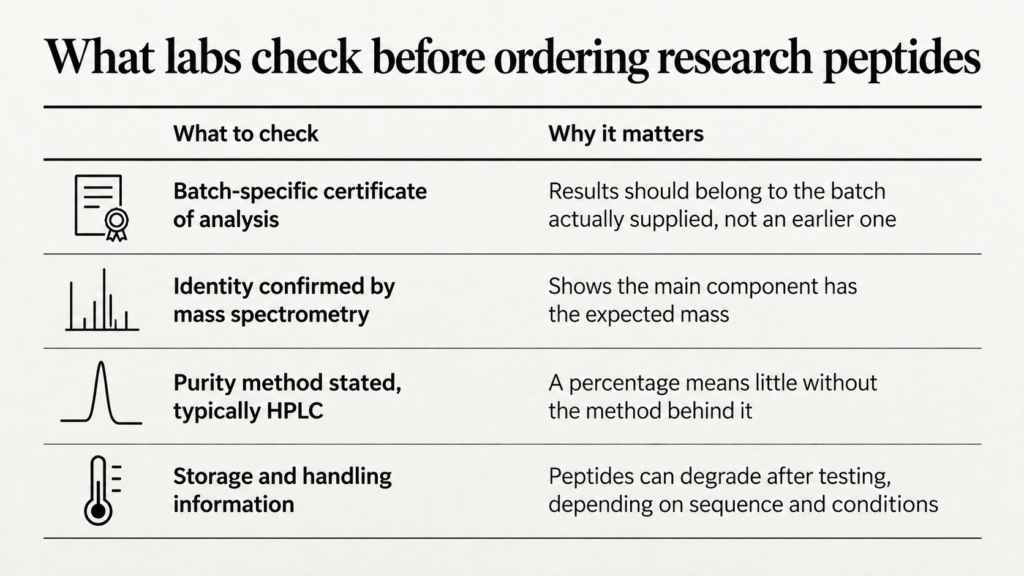
Labs that buy research peptides for this kind of work therefore tend to judge a supplier by its documentation as much as by its catalogue:
Peptides supplied on this basis are laboratory materials, made and documented for experiments, and not intended for use in people or animals.
In September 2023 IOCB Prague, its technology-transfer company i&i Prague, the Czech Academy of Sciences’ Institutes of Biotechnology, Microbiology and Molecular Genetics, and the University of Chemistry and Technology, Prague, announced a joint biotechnology cluster called Prague.bio. Its purpose is to bring academic research and business closer together, and in May 2024 Zentiva joined as its first industry partner. The peptide work of the 1950s and 1960s is part of the scientific inheritance the cluster now builds on.
Would you like your story featured here? Get in touch with our team at [email protected]



Already have an account? Log In