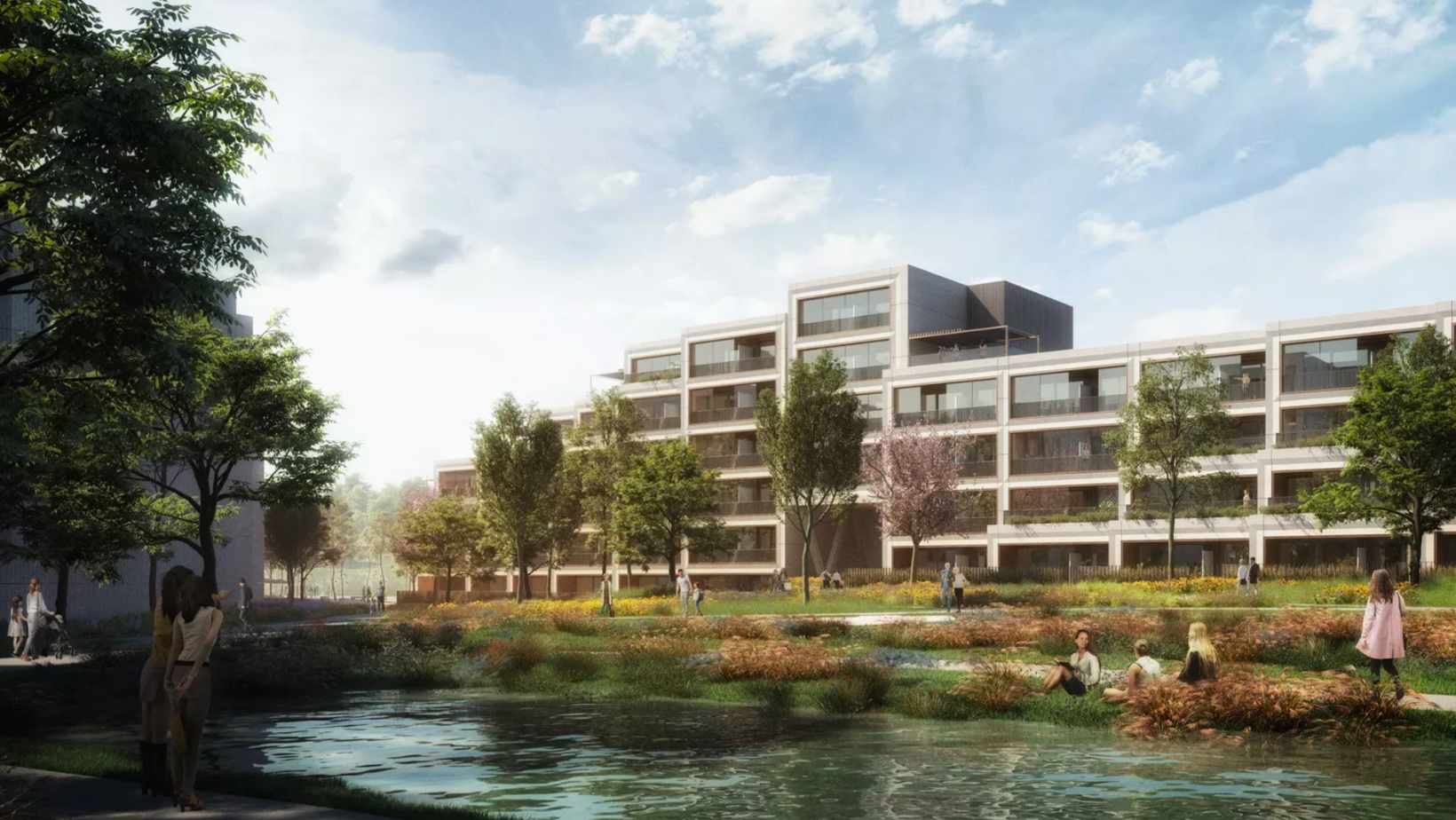
A new high-rise complex is set to reshape the area above Prague’s National Museum, with developers moving forward on a project that will combine housing, offices, and retail space just steps from Wenceslas Square. Private investors behind the project, known as Vinohradská 8, have secured a building permit and plan to begin construction with completion expected in the second half of 2028. The development will stand at the start of Vinohradská Street, in a location long considered one of the most visible in the Czech capital. According to the developers, the project will include around 7,500 square meters of office space facing Vinohradská Street. The ground floor is expected to host shops, cafes, restaurants, and services aimed at both residents and visitors. Nearly 200 apartments will be built in a quieter courtyard section of the complex, offering a mix of unit sizes. Plans also include underground parking with charging stations for electric vehicles. A rooftop viewing point overlooking Wenceslas Square is expected to be one of the defining features of the building, adding a new public vantage point in the city center. The timeline for construction is linked to nearby infrastructure upgrades. The project is expected to follow the completion...
Prague has added nearly 150,000 residents in the past five years, yet apartment construction is far behind this pace. The capital’s living conditions, high salaries, and abundant career opportunities continue to attract newcomers, fueling an unprecedented demand for housing. Last year alone, Prague’s population grew by 9,204 people, according to the Czech Statistical Office (CZSO). Over the same five-year period, only 26,636 new apartments were completed. This means that for every newly built apartment, more than five new residents are competing for housing. The imbalance is creating a sharply worsening housing shortage. Migration is the main driver of this growth. In 2025, 57,432 people moved into Prague, while 47,046 left. Natural population changes due to births and deaths account for the remaining increase, resulting in a net gain of 9,204 residents for the year. Prague’s appeal is clear. It ranks among the wealthiest regions in the EU, with low crime rates, extensive public transport, accessible healthcare, and rich cultural and sports offerings. Its economic and social advantages are unlikely to diminish, ensuring that population growth will continue. Updated projections by the Institute for Planning and Development (IPR) estimate that Prague could gain another 300,000 residents by 2050. Even this “realistic...

This article has been written by Finaram.cz, a Czech platform specializing in mortgages, home financing, and real estate advice. For many expats living and working in Prague, the question comes up sooner or later: does it still make sense to rent, or is it time to consider buying? With rising rents, relatively stable mortgage conditions, and long-term plans becoming clearer for many professionals, 2026 is shaping up to be a turning point for this decision. Renting: Flexibility Comes at a Cost Renting remains the obvious choice for those who value flexibility. If you’re unsure how long you’ll stay in Prague, or you prefer not to commit financially, renting gives you freedom. But that flexibility comes with a trade-off. Rental prices in Prague have continued to increase in recent years, and many landlords adjust rent annually. Over time, this creates a compounding effect that significantly increases your total cost of living. View this post on Instagram A post shared by Finaram | Expat Mortgages (@finaram.cz) Buying: Higher Entry, Long-Term Stability Buying property, typically through a mortgage, requires more upfront commitment. A down payment, paperwork, and long-term planning are all part of the process. However, it offers something renting...
This article has been written by Finaram.cz, a Czech platform specializing in mortgages, home financing, and real estate advice. For many foreigners living and working in Czech Republic, buying property is a natural next step. But getting a mortgage as a non-citizen comes with additional requirements. Czech banks apply stricter criteria to foreign applicants and carefully assess income stability, residency status, and financial history. Here’s what you need to know in 2026. Bank or Non-Bank: What’s the Difference? Bank Mortgages Czech banks are the main source of mortgage financing and operate under strict regulations set by the Czech National Bank (ČNB). Advantages: Lower interest rates Strong consumer protection Disadvantages: Longer approval process Higher requirements for income and residency Banks pay particular attention to employment stability, income sources, and credit history — especially for foreign applicants. Non-Bank Options Some non-bank institutions (such as building savings banks – stavební spořitelna) may offer more flexibility and approve cases that traditional banks reject. However, this usually comes at a cost: Higher interest rates Additional fees Fewer legal protections What Affects Mortgage Approval? Citizenship and Residency EU citizens generally face fewer obstacles. For non-EU nationals, requirements are stricter — particularly without long-term residence or...
A former industrial site in western Prague is set to be transformed into a new residential neighborhood, as developers move forward with a project on land once occupied by a thermal power plant in the district of Veleslavín. Developers Penta Real Estate and EPD Radek Pokorný have secured a building permit for the project, which will be built near the historic Veleslavín Castle in Prague 6. The investment is estimated at around 2.2 billion Czech crowns, according to the developers. Construction is scheduled to begin in June, alongside the launch of apartment sales. The new neighborhood is expected to be completed in 2028. The project will replace the demolished industrial structures with a combination of apartment buildings and townhouses. Plans call for 114 apartments and 27 townhouses, creating a residential area designed primarily for family housing. Architectural plans were prepared by the studio smilemiamilakes.com/services Schindler Seko, which designed two apartment buildings alongside rows of family houses. The apartments will range up to four-room units with kitchenettes. According to the architects, the layout aims to connect naturally with the surrounding residential fabric of Prague 6. The development will draw inspiration from the architectural style associated with the First Czechoslovak Republic, a period...
Navigating the Czech real estate market can feel overwhelming for international buyers. Here’s how to make your property purchase smooth, legal, and financially smart. Prague has never been more attractive to international buyers. With property prices continuing their upward trajectory through 2025 and the city cementing its position as Central Europe’s tech and business hub, more expats are asking: “Should I buy instead of rent?” The answer increasingly is yes—but only if you navigate the process correctly. The Czech property market offers competitive value compared to many Western European capitals, but it comes with unique challenges for foreign buyers. Here’s what you need to know. The Current Market: Opportunity Meets Complexity Prague’s residential property market is experiencing what analysts call a “perfect storm” of rising demand and constrained supply. As of early 2026, median apartment prices in Prague stand at approximately 8.1 million CZK (around $393,000 or €334,000), with prices per square meter ranging from 97,000 CZK/m² in outer districts to over 200,000 CZK/m² in Prague 1 and 2. For expats who’ve relocated here for work or lifestyle, this creates a compelling investment case. Prague remains competitively priced compared to Amsterdam (30-40% less) and comparable to Berlin, while offering Central...
A large residential project is set to reshape the former Žižkov Freight Station area in Prague 3. Slovak developer Cresco Real Estate plans to build up to 1,100 apartments on land it acquired from Finep together with the investment group Wood & Company. The development already has a valid building permit, and construction of the first phase is expected to be completed in 2028. Cresco previously entered the Czech market with the Soho Holešovice project. The Žižkov development marks its second major investment in Prague and one of the first large-scale housing projects to move forward on the long-unused freight station brownfield. The project is named Yards Žižkov, a reference to the English term “freight yard” and to the inner courtyards that will shape the block-style layout of the buildings. The development will follow the urban plan for the area, with perimeter blocks and shared inner spaces rather than isolated buildings. According to Cresco’s Czech CEO Aleš Svatoň, the company aims to approach housing as part of the wider city structure, with a focus on public space and everyday use rather than standalone residential buildings. Housing will form the core of the project. Around 1,100 apartments will be built in...
Developer PSN has received a building permit to construct a large residential complex on the site of the former Koh-i-Noor industrial factory in Prague’s Vršovice district. The project will deliver around 600 apartments, combining new residential buildings with the reconstruction of historic factory structures. Two listed buildings from the former industrial complex will be preserved and converted for residential use. According to the developer, the most visible industrial landmark of the site, the original factory chimney, will remain intact. It is expected to continue shaping the Vršovice skyline and serve as a visual link to the area’s industrial past. The residential block will also include public spaces, local services, and community facilities, aiming to integrate the development into the surrounding neighborhood rather than function as a closed housing enclave. PSN has not disclosed the total investment value of the project. Preparatory work is scheduled to begin in the second quarter of this year. The developer plans to present the final architectural design to the public later this year. Construction will be carried out in at least two phases. According to PSN Development Director Štěpán Smrčka, the full build-out of the site is expected to continue until 2030. PSN has operated...
Prague 6’s northwest district of Ruzyně is set for a major transformation, with a 622 million CZK investment bringing kindergartens, public spaces, and new infrastructure to the area. Once known for warehouses and logistics facilities, Ruzyně is shifting toward a community-focused vision. The former WestPoint Distribution Park will be redeveloped into a neighborhood where bicycles, playgrounds, and public life replace industrial activity. “We will provide funding and land for a new public park, a communal square, a railway station, and an elementary school,” said Dušan Kunovský, CEO and founder of Central Group. The project plans up to 2,200 apartments, accommodating roughly 6,000 residents. Shared spaces, educational facilities, and carefully planned streets aim to create an open, connected neighborhood. “This project will absorb the lively nature of the area—no gated communities, with a well-thought-out street network,” said Petr Hlavaček, Prague Deputy Mayor for Territorial and Strategic Development. The development emphasizes community integration, linking housing with services and daily life. “The new district will feature an integrated transport system connected to Prague Airport, making it part of the city rather than isolated,” Hlavaček added. Public transport will play a central role. Tram line Divoká Šárka – Dedina will run near the district,...
Central Group, the country’s largest residential developer, announced that it will delay the launch of all new construction projects for the next year. The company says the market has reached a level of overheating that no longer allows investors to price new developments responsibly. The decision comes at a moment when the developer is experiencing one of its strongest years on record. Across Prague, the group currently has around 3,200 apartments under construction and reports strong sales. Yet founder Dušan Kunovský told reporters that the company is no longer willing to begin new projects under current cost conditions. According to Kunovský, the price of construction work and building materials has climbed to a point where buyers would be forced to absorb increases that he considers unsustainable. He described the trend as a “market that needs cooling,” adding that the company is taking a step back to avoid pushing apartment prices even higher. Despite the decision, all projects already under construction will continue as planned. For developments currently in the tender phase, Central Group expects to determine within the next three months whether those projects will move forward or be pushed back. This is not the first time the developer has...
Construction has begun on Kappa, a new residential building in Prague’s Hagibor district, located directly next to the Želivského metro station. Developer Crestyl Group launched the project in October, with Metrostav DIZ serving as the general contractor. Completion is expected by the end of 2027. Kappa will be the fifth residential building in the Hagibor complex, which is gradually transforming the area into a modern urban quarter. The project aims to combine housing, offices, shops, and services within one integrated neighborhood. The new building will feature more than 250 apartments, ranging in size from 27 to 180 square meters. The design includes compact one-bedroom units on lower floors and larger family apartments with balconies on the upper levels and recessed towers. On the ground floor, space will be reserved for shops, restaurants, and resident services, along with a reception area and courtyard for relaxation. Designed by Ian Bryan Architects, who are responsible for all residential buildings in the Hagibor development, Kappa will meet the BREEAM sustainability standards, emphasizing energy efficiency and environmental responsibility. The building will also include underground parking with electric vehicle charging stations. The public spaces for the Hagibor complex are being created by Michel Desvigne, a globally...
The long-planned renovation of Prague’s Kotva department store has been delayed once again. Generali Real Estate, which owns the landmark building on Náměstí Republiky, has moved the expected completion date of the reconstruction to 2028, extending the timeline by at least a year. The company initially announced that the extensive modernization, which began in February 2025, would finish by the end of 2027. “The rehabilitation of such a large and technically complex building is a long-term process that demands careful coordination and patience,” said Jana Vrábelová from Generali Real Estate. “We appreciate the cooperation of authorities, experts, and the public throughout this stage.” The next step involves selecting a main contractor for the full-scale reconstruction, which will include modernizing the interiors, expanding commercial and office space, and restoring the building’s architectural character. Plans envision six floors dedicated to retail and services, along with two floors of offices. While the façade will be replaced, Generali intends to preserve Kotva’s distinctive brutalist design, including its hexagonal concrete structures and communication towers. The building’s honeycomb-like grid, inspired by architectural structuralism, remains one of its most recognizable features. Kotva, designed by architects Věra and Vladimír Machonin, opened in 1975 as a symbol of modern...
Don’t have an account? Register
[swpm_registration_form level=”6″]
Already have an account? Log In
How Would You Like to Promote Your Business? PR ArticleDisplay bannersVideo productionNewsletter adsJob ListingsInfluencer Marketing
Your Email
We will come back to you within 24 hours with our proporsal