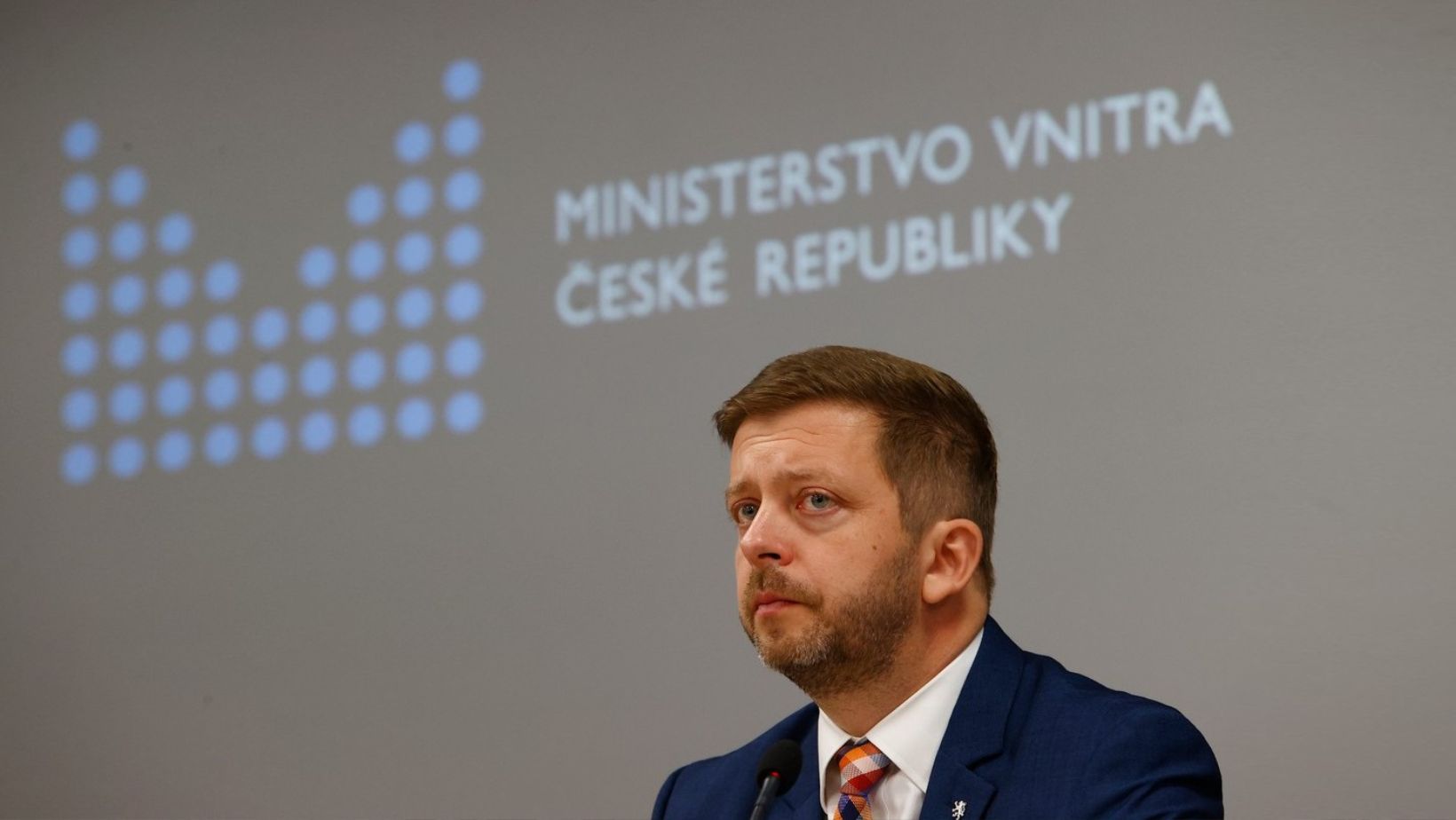
There is currently no evidence of radicalisation of the Muslim community in the Czech Republic, Czech Interior Minister Vít Rakušan (STAN) said on Sunday in light of increasing terrorism-related incidents across the EU. “At this point, we have no indication that there is radicalisation in the Muslim community in the Czech Republic,” Rakusan told Czech Television on Sunday. He also pointed out that the Muslim community in the country is not significant, and events in support of Palestine organised in Czechia were not primarily Muslim events, unlike those in Berlin and Paris. Sociologists estimate that roughly 20,000 Muslims live in the Czech Republic. The minister said police extremism experts supervise the pro-Palestinian events. Rakušan also stressed that sharing terrorist content is unacceptable in the Czech Republic, adding that no statement at the demonstrations explicitly supported Hamas. All pro-Palestine demonstrations in the Czech Republic have so far been peaceful. “We will not allow terrorism to be supported in any way in the Czech Republic, we will intervene at that moment,” said Rakušan. According to the minister, national security forces are still assessing the situation, and the state is ready to raise the terror risk level if necessary. He added that he...
Today, on 24 October, the second parliamentary summit of the International Crimean Platform will take place in Prague. The purpose of the platform is to reaffirm international support for Ukraine and draw the world’s attention to the situation on the Crimean peninsula, which was annexed by Russia in violation of international law in 2014. The summit will be opened by the heads of both chambers of the Czech parliament – the House of Representatives and the Senate – and the Speaker of the Verkhovna Rada of Ukraine, after which President of Ukraine Zelenskyy will address the assembly in a video address. The delegates will also meet with Czech President Petr Pavel and Prime Minister Petr Fiala. “It is impossible to try to occupy the territory by aggression,” said the Speaker of the House of Representatives of the Republic of Moldova, Pekarova Adamova, on the eve of the summit. She noted that a resolution would be adopted during the meeting, which would “unequivocally condemn Russia’s aggression against Ukraine and the occupation of Crimea”. According to the organizers, the summit is being attended by high-ranking representatives of parliaments from more than 40 countries, as well as international parliamentary assemblies and organizations. In...
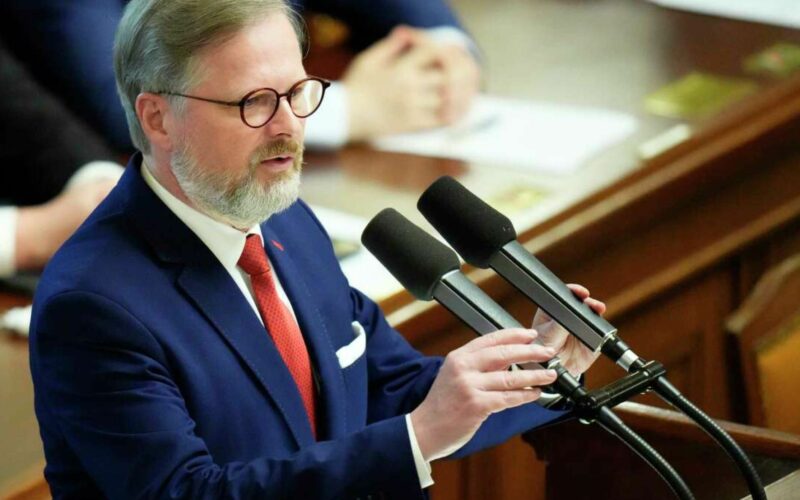
Czech Prime Minister Petr Fiala said at the SH!FTS conference that the future of Western civilisation and its basic values, such as respect for human life and respect for civilians, are at stake in Ukraine and Israel. Fiala said that the nature of the conflict in Israel and the war in Ukraine is different: Russia’s aggression against Ukraine is a brutal but conventional military clash, while the attack by the Palestinian Hamas movement on Israel is pure terrorism. However, Fiala noted, what they have in common is that Western civilisation is under attack and that both attacks will affect the international environment in the next decade. “Security crises force us to respond to them and to change under their pressure,” Fiala said. He added that Czechia must refuse to be careless and prepare for all threats as best as it can. “There is no prosperity without security,” he stressed. That is why it is necessary to support those who have been attacked by aggressors, Fiala said. He stated that the conflicts have also highlighted the importance of strengthening the resilience of the Czech Republic. The Prime Minister reiterated that Czechia is increasing defence spending, which will reach 2% of GDP...
The Czech parliament’s lower house has approved dozens of measures proposed by the government designed to keep the ballooning budget deficit under control. Czech citizens are a step closer to paying more for beer and medicine while businesses will face higher corporate taxes. In the 200-seat house, 108 MPs from the ruling coalition voted in favour of the plan, while 86 opposition members were against. When the government introduced the package in May, Prime Minister Petr Fiala said the proposed cuts, tax increases and austerity measures are necessary because the pace of the debt rise is “threatening.” Fiala said Friday the measures should reduce the budget deficit by 97 billion Czech crowns next year and by 150 billion in 2025. As a result, the deficit of 3.5% of the GDP expected for this year should drop to 1.8% next year and to 1.2% in 2025. The package still needs approval from the upper house, the Senate, where the coalition government has a majority, and presidential approval before becoming effective next year. Rising beer tax Corporation tax will go up by two points to 21% while property tax for individuals will be also increased, as well the tax on alcohol, tobacco...
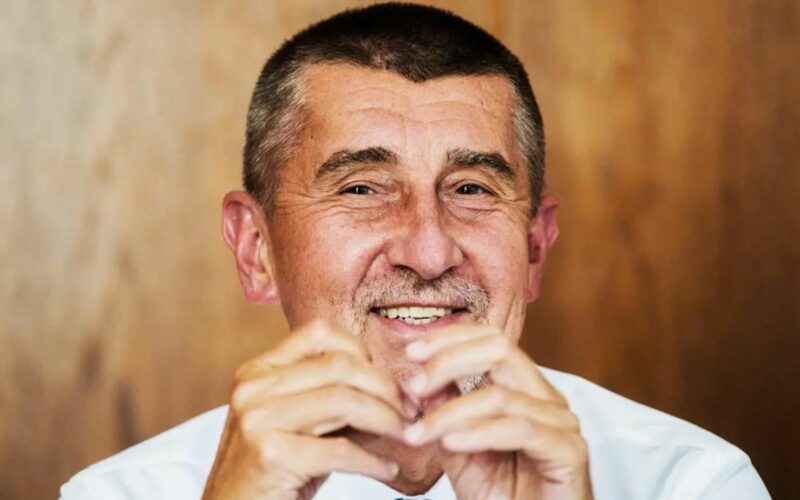
The Czech opposition ANO party of former Prime Minister Andrej Babiš would win the Czech general election with 33.5% of the vote if elections were held now, according to a new opinion poll. The current Kantar election model for Czech Television also shows that the Pirates (Greens/EFA), STAN and TOP 09 (EPP) would still make it into the Czech Chamber of Deputies. At the same time, the Christian democrats (KDU-ČSL, EPP) would not pass the 5% threshold. By a wide margin, the currently governing ODS (ECR) would get 12%, with its support falling by 5% since the spring of 2023. The far-right party of Freedom and Direct Democracy (ID) would finish third with 9.5% of the vote. The current Czech government was formed in 2021, consisting of five parties – ODS, KDU-ČSL, TOP 09, Pirates and STAN. All the parties are significantly lagging behind the populist ANO party. The most noticeable outflow is from ODS towards ANO or Freedom and Direct Democracy. “The most frequently mentioned reasons for the shift are incompetence, inconceptiveness, chaotic, failure to fulfil promises, but there are also economic reasons such as high inflation, falling real wages and related reasons such as inaction, poor communication,” the...
Israel has the right to defend itself against Hamas attacks, according to various Czech politicians, with some calling for an end to EU funding for Palestine. “The rocket attacks and the infiltration of Hamas commandos into Israel will block any efforts for a peaceful solution to the Palestinian-Israeli conflict for a long time. This aggressive action will inevitably provoke a harsh and justified reaction from Israel, which will bring many casualties,” Czech President Petr Pavel commented on the situation, adding that the way to settle the problem is through the negotiating table with “a great deal of goodwill.” Foreign Minister Jan Lipavský (Pirates) spoke with his Israeli counterpart over the weekend, where he “told him that the Czech Republic fully stands behind Israel and its right to self-defence. We also reiterated this position within the European Union,” Lipavský said. MEP Jan Zahradil, a member of the ruling ODS (ECR) party, called for a reduction in European support for the Palestinians. “Our group (ECR) will push for this in the European Parliament. This concept needs to be thoroughly examined and reconsidered. It is completely unacceptable to spread hatred towards Israel with European money,” he said on the social network X. EU...
Czech trade unions will demand salary increases between 8% and 10% next year to compensate workers for the impact of high inflation, the head of the country’s biggest labor union said. Households in the central European country are reeling from the worst cost-of-living crisis in three decades that caused a deep drop in real income. Consumer price growth has been easing from a peak of 18% a year ago, with the central bank predicting it to slow toward the 2% target in early 2024. “Inflation is causing the biggest problems that we have,” Josef Stredula, the chairman of the Confederation of Trade Unions, said in a debate on public TV on Sunday. “Purchasing power is declining.” Central bankers in Prague are closely watching wage trends as a key factor for their monetary-policy deliberations. The bank last month began discussing a plan for lowering borrowing costs, but it listed the country’s tight labor market — the Czech jobless rate is one of the lowest in the European Union — among inflation risks. The central bank forecasts average inflation at 2.1% next year and predicts nominal wage growth of around 8%.
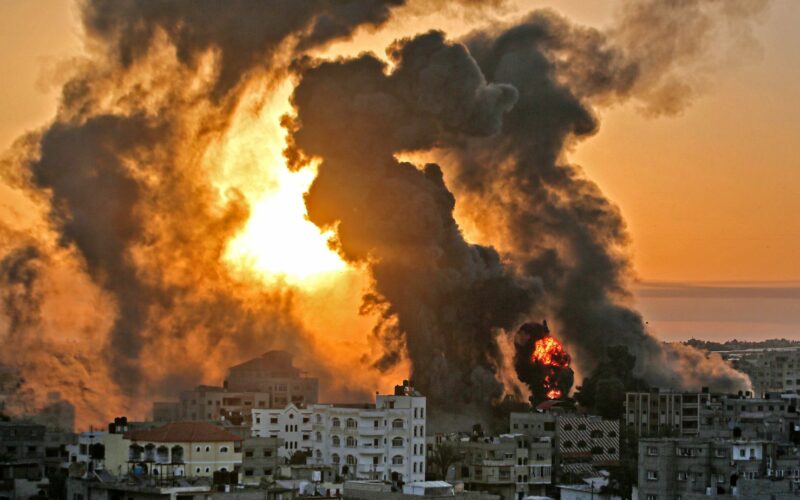
The Czech president and the head of government “unequivocally condemn” a surprise attack by Palestinian Islamist group Hamas on Israel on Saturday. “I condemn the terrorist attacks on Israel,” Czech Prime Minister Petr Fiala said on X, formerly known as Twitter. “My thoughts are with the innocent victims of the violence and I wish our friends in Israel the swiftest possible handling of the situation and the fulfilment of their ambitions to live in peace and security. The Czech Republic has always stood and will stand fully with Israel,” he added. “We follow with anguish the news coming from #Israel. We unequivocally condemn the attacks by Hamas. This horrific violence must stop immediately. Terrorism and violence solve nothing. The EU expresses its solidarity with Israel in these difficult moments,” EU foreign policy chief Josep Borrell said. What happened Hamas launched the biggest attack on Israel in years on Saturday in a surprise assault that combined gunmen crossing into several Israeli towns with a heavy barrage of rockets fired from the Gaza Strip. As warning sirens wailed across southern and central Israel, including in Jerusalem, Israel’s military said it was on a war footing and the defense minister said the Iran-backed...
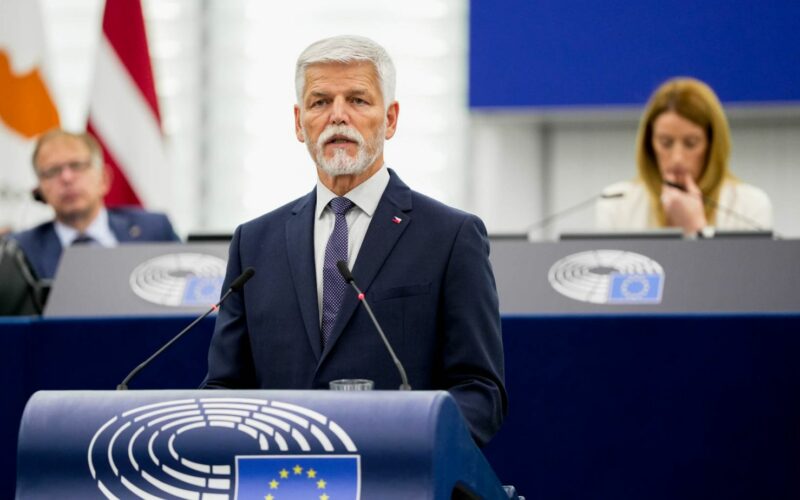
During his address at the European Parliament on Wednesday, October 4, Czech President Petr Pavel called for a dialogue with citizens, a fight against populism and a policy of no concessions to Putin. President Pavel stressed the importance of explaining Europe “to ensure that our citizens can genuinely identify with the principles we stand for”. Speaking of the European election campaign next year, he urged to refrain from “simplistic solutions and empty promises” and to communicate problems “as they really are” instead. Petr Pavel warned that if “Ukraine fails, so will we” and called “on everyone to continue providing support by all possible means”. Recalling that Czechoslovak territory was ceded to Hitler in the hope of appeasing him and avoiding war, he spoke strongly against offering concessions to Putin and called for “a settlement that safeguards the necessary conditions for Ukraine’s continued existence in lasting peace and prosperity”. Speaking in favour of enlarging the EU, he said that “it is in our interest that candidate countries succeed. Their success will be our own success”. On the Fit for 55 package, he stressed the need “to overcome the insecurities of our people about their future, especially the younger generation” and to...
Europe should reduce its reliance on the U.S. and strengthen the European pillar of NATO instead, Czech President Petr Pavel said Tuesday. “The dominant role of NATO as a security provider must no longer mean that Europe neglects its defense obligations,” said Pavel, speaking at the opening ceremony of the new academic year at the College of Europe in Bruges. “Reducing the reliance on the U.S. and developing European strategic enablers is to be seen as our contribution to our transatlantic partnership. “Very likely, we will have to go beyond the 2 percent spending on defense,” he noted. NATO allies agreed at the Vilnius summit in July that the target, in the words of Secretary-General Jens Stoltenberg, should be treated as a floor instead of a ceiling. “We affirm that in many cases, expenditure beyond 2 percent of GDP will be needed,” the joint communiqué stated. Only about a third of the 31-strong alliance — including many Eastern allies — is meeting or close to meeting the target. In his speech, Pavel also supported enlargement, which “should not be postponed until some hypothetical point in the future, where the candidates are perfectly aligned with us,” and emphasized Western countries must...
EU accession negotiations with Ukraine should be opened in autumn 2023 or early next year, Czech Foreign Minister Jan Lipavský said at the meeting of EU foreign ministers in Kyiv on Monday. According to Lipavský, the meeting in Kyiv was not just symbolic but also included important discussions about practical solutions on what the EU can do to ensure peace in Europe. “It was clearly stated that if Ukraine is in the European Union, it will be a clear security guarantee because the European Union is also a peace project. However, it is true that Ukraine must change, and adapt its law to EU law. It is a long run,” Lipavský said, as quoted by the Czech News Agency. During the meeting in Kyiv, Lipavský emphasised that EU accession negotiations with Ukraine should be opened in the autumn or early next year. “This is a technical process during which it will be assessed how ready Ukraine is. It will be clear to see where it still needs to work,” the Czech minister noted, adding that it is in Europe’s interest that Ukraine is able to adopt all the necessary standards and adapt its legal system. Monday’s meeting in Kyiv represents the first time...
Former Prime Minister Robert Fico’s leftist-populist Smer party won Saturday’s election in Slovakia after promising to stop sending weapons to Ukraine, to block Kyiv’s potential NATO membership and to oppose sanctions on Russia. With 98 percent of ballots counted in the country of 5.5 million people, Smer had 23.4 percent of the vote, ahead of the liberal, Western-oriented Progressive Slovakia by nearly seven percentage points and almost 200,000 votes. The election winner gets the first chance to form a majority in the 150-seat parliament. Fico’s campaign has raised alarm across the Continent amid fears that he will shift Slovakia to the anti-Ukraine camp alongside Hungarian Prime Minister Viktor Orbán. Fico has taken a very pro-Moscow stance, vowing to end arms deliveries to Kyiv and opposing sanctions even as Russian President Vladimir Putin’s invasion of Ukraine continues after a year and a half. Despite Slovakia’s profound polarization, Fico is in a strong position to return to power with the support of Hlas (Voice), a social-democratic party that split from Smer. Hlas finished third with 15 percent in Saturday’s vote. Saturday’s ballot has been viewed as pivotal to Slovakia’s future, not only due to Fico’s vows to abandon aid to Ukraine, but...
Don’t have an account? Register
Already have an account? Log In
How Would You Like to Promote Your Business? PR ArticleDisplay bannersVideo productionNewsletter adsJob ListingsInfluencer Marketing
Your Email
We will come back to you within 24 hours with our proporsal