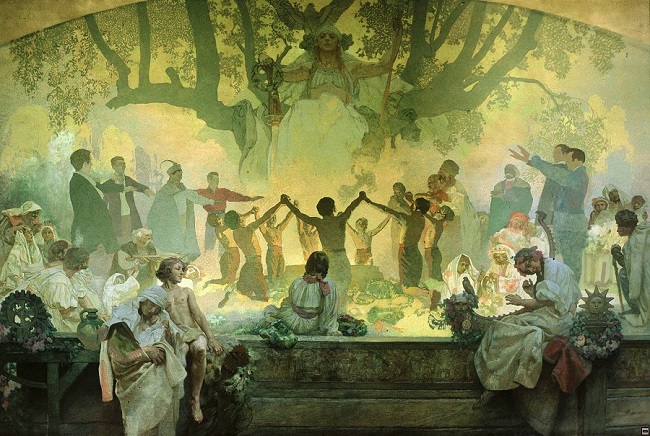
The Slavic Epic by Alfons Mucha could be temporarily displayed in the Savarin Palace, acquired in 2015 by Crestyl company. The canvas would move after a five-year loan to Moravský Krumlov and for a maximum of 25 years. The Slav Epic (Czech: Slovanská epopej) is a cycle of 20 large canvases painted by Czech Art Nouveau painter Alfons Mucha between 1910 and 1928. The cycle depicts the mythology and history of Czechs and other Slavic peoples. In 1928, after finishing his monumental work, Mucha bestowed the cycle upon the city of Prague on condition that the city builds a special pavilion for it. In 2012, all 20 works were moved and displayed together on the ground floor of the Veletržní Palace until 2016, in an exhibition organized by the National Gallery in Prague. In December, the District Court of Prague has ruled against the capital in a case regarding the cycle of paintings. The lawsuit was filed by the artist’s grandson John, who claimed that the city had violated the terms of a 1913 agreement between Mucha and his benefactor, the American philanthropist Charles R. Crane, which stipulated that the works would be gifted to Prague on the condition that the city build a pavilion to house them. “The Slavic Epic...
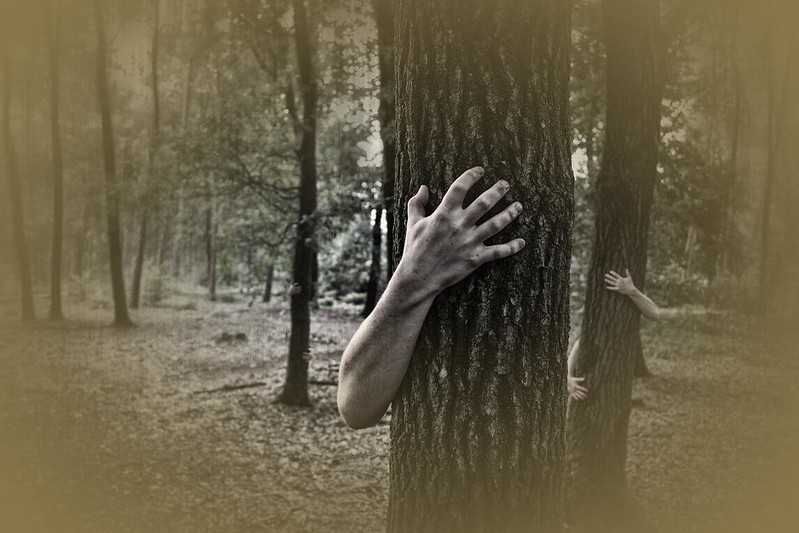
Looking for a hair-raising experience? Then make your way to one of the 3 most haunted places in the Czech Republic (if you dare…)! Bor forest The mysterious Bor forest, also called Branišovský forest, is located southwest of Česke Budějovice. This forest hides many scary mysteries and stories told by the daredevils who have passed. Soldiers who have served in the area recall hearing strange melodies sung by a male voice. People have seen a male figure hovering a few centimeters above the ground with glowing red eyes wearing a black jacket and hat. Four hundred years ago, there was a settlement that lined the narrow road that connected the village to the outside world. The area was full of deep swamps where many people met their premature deaths. A few years ago, there stood a hanging tree. Over the course of several years, many people had taken their lives on the tree. Finally, villagers decided to burn down the cursed tree. To make matters worse, one night an unknown flying object crashed into the forest. The area was closed for a year and nobody couldn’t enter it – not even soldiers. Velhartice’s cemetery This story may be unknown...
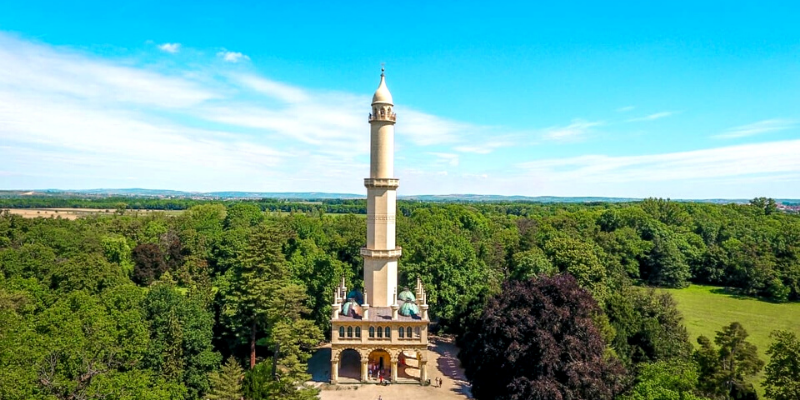
The Minaret or the ‘Turkish Tower’ is located on the grounds of the Lednice Castle Gardens. This attractive tower was built by Prince Alois Joseph I according to plans by architect Josef Hardtmuth – the famous pencil inventor and founder of the Czech firm Koh-i-noor, a major manufacturer of pencils and crayons. – at the turn of the 18th and 19th centuries. It is an exceptional construction of this character in Europe and stands almost 60 metres high – making it one of the tallest on the continent. However, we need to specify that it is not a religious building: it was built to give the park an exotic note, bringing the symbolic element of the Islamic culture to central Europe. The slender tower has three viewing platforms and serves as an unconventional lookout tower in the summer months; 302 stairs take you to the top. While the Minaret can be easily reached on foot through the chateau grounds, a cruise route also leads to it; boats depart from the jetty below Lednice Chateau. The lower part of the tower has eight rooms with ceilings, walls, and floors richly decorated with oriental ornaments. According to experts, this decorative work was carried out by artists from Arab countries....
Ever since Covid-19 brought concerts and tours to a crashing halt this spring, the global live music industry has been in a bind. It was one of the earliest industries forced to shut down, and it will likely be one of the last to reopen. In the meantime, promoters and booking agents have lost jobs, venues have shuttered, artists have been cut off from one of their most reliable streams of income, and thousands of tour crew members have faced a financial and existential reckoning. Many artists have moved their gigs to 2021 in the hope that it will not be necessary to cancel them… once again. Dead Can Dance announced their return to Prague on Saturday 27th and Sunday 28th March at the Prague Congress Center. The last concert by Lisa Gerrard and Brendan Perry was sold out in two hours. Famous guitarist Joe Satriani postponed his European tour for a year due to a coronavirus pandemic. He is scheduled to perform at the Congress Center on May 15. In addition to songs from the new album, the concert program included classic songs from the guitarist’s repertoire such as Surfing With The Alien, Cherry Blossoms, and Flying In A Blue Dream. The Finnish...
We are now very familiar with robots – machines that possess artificial intelligence and perform tasks that humans find arduous or simply unattractive. What you might not know is that the word robot comes from the Czech for “forced labour”. It was first used to mean an artificial humanoid in the stage play R.U.R. written in 1920 by Karel Čapek, which premiered on January 2, 1921, by the Unity of Klicper Theater Amateurs in Hradec Králové, and the official premiere was at the National Theater in Prague on January 25, 1921. The acronym stands for Rossumovi Univerzální Roboti and translates to English as Rossum’s Universal Robots. The title refers to the creations of Mr. Rossum, a Frankenstein-like inventor and possible inspiration for Metropolis’s Rotwang (who was himself an inspiration for Dr. Strangelove). Čapek told the London Saturday Review after the play premiered that Rossum was a “typical representative of the scientific materialism of the last [nineteenth] century,” with a “desire to create an artificial man—in the chemical and biological, not mechanical sense.” While others credit Karel Čapek, as the author of R.U.R., with coining the term, he insists it was in fact his older brother Josef, best known as a painter, but also noted as a writer and a...
When massive antigovernment demonstrations erupted in Prague in November 1989, Havel became the leading figure in the Civic Forum, a new coalition of non-communist opposition groups pressing for democratic reforms. In early December the Communist Party capitulated and formed a coalition government with the Civic Forum. On 29 December 1989, Václav Havel, an opponent of Gustáv Husák’s Communist regime, is elected interim President of Czechoslovakia pending parliamentary elections. Initially reluctant to take up the post, the playwright turned president guided his country to greater freedoms.
The 74th edition of the oldest Czech winter swimming contest will be held near the National Theatre, between Slavonic Island and Střelecký Island. The event will start at 11 a.m. on December 26 and will be attended by hardy men and women. In addition to the antigen test, organizers will measure the temperature of all participants. At the entrance to Slovanský ostrov, everyone is obliged to wear face masks. Spectators will not have access to Slovanský ostrov, while organizers will ensure they do not gather on the adjacent embankments, bridges and neighboring islands. The awards ceremony will take place in the Small Hall of the Žofín Palace. The memorial is called after Alfred Nikodém, who was a goldsmith in Prague and a proponent of Spartan lifestyle. Winter swimming was first seen in Prague in 1923 when he and six other enthusiasts plunged into the freezing cold Vltava River watched by a crowd of stunned on-lookers. 430 swimmers launched themselves in the cold waters of Vltava river during the last edition. Swimmers came from the Czech Republic, Slovakia, Poland, Belgium, England, Russia, and Kazakhstan. Since 1947, this race is celebrated on December 26th – with swimmers of all ages, competing in three distances: 100,...
The ban on concerts and gatherings due to COVID-19 safety precautions didn’t take the air out of the Prague Symphony Orchestra’s holiday spirit. The orchestra – traditionally known by the acronym ‘FOK’, standing for ‘Film-Opera-Koncert’ – recently announced that will be broadcast on its YouTube channel live concerts, as well as talks with experts about Christmas, accompanied by the production of symphony orchestras. Concerts on the web and social networks On Monday, December 21, Prague Radio Symphony Orchestra’s (PRSO) Christmas evening will bring Baroque and modern music with live streaming on YouTube. The orchestra’s concertmasters, violinists Vlastimil Kobrle and Petr Zdvihal, and cellist Pavel Ludvík will open with the Christmas Concerto with the Italian composer Arcangelo Corelli. Prague 3 will broadcast the Consortium Pragense Orchestra concert. It will take place in the Bethlehem Chapel on Saturday, December 19 at 5 pm, and you can watch it here. Prague 9 will also offer a Christmas online program, together with the Gong Theater. The events will be streamed on the website and Facebook theater page. Prague nativity scenes Nativity scenes can be enjoyed at the Church of Our Lady Victorious in Malá Strana. Visitors can find a contemporary Nativity scene, decorated by...
The U.S. Embassy Prague joined the “Short Trousers For Václav Havel” initiative to honor his legacy on December 18, 2020. “Short Trousers For Václav Havel” initiative marks the anniversary of the death of Václav Havel (December 18, 2011), the country’s first post-communist president, by rolling their pants up to remember Václav Havel’s first inauguration to the presidency in December 1989, when he wore visibly short trousers. The “trousers” reference dates back to Havel’s inauguration as Czechoslovak president on December 29, 1989, when cameras caught the almost painfully reticent champion of the Velvet Revolution in pants that barely reached his ankles. Years later, in a 2006 interview, Havel tried to dispel what he called a “national myth” by saying he’d simply adjusted his pants during the ceremony and they hadn’t settled in time for the cameras, which had turned on him earlier than scheduled. “Every man knows that we pull our trousers up from time to time and then it takes some time before they get back into the original position. That’s what happened at that time at the castle. And because the military parade took place in the fourth minute instead of the fifth, since then it has become...
The Socks from Grandma (Ponožky od babičky) brand was founded by the non-profit organization Elpida. This organization helps seniors since 2002 be a respectful and meaningful part of our society. They also run the Elpida Educational and Cultural Center for seniors from all over Prague and the Help Line for Seniors. Socks are knitted by more than 200 grandmothers from all over the Czech Republic – so each sock is original. Each pair is knit by a specific grandmother, whose name appears on the cover of each pair of socks. Elpida supports recycling, that is why socks are knitted from donated wool and send to knitters, who knit original warm socks and receive a fee for them. You can buy socks in their e-shop, in markets, or through contracted sellers. By selling socks they also raise money for other activities in the Elpida Center. One pair of socks costs 299 crowns. Your money will help them three times. It will support lonely seniors, grandmothers who have knitted socks, as well as educational and cultural activities for seniors at the Elpida Center. Socks from these grandmothers will make a great meaningful gift for Christmas to your loved ones.
Navigating a new city is full of challenges, especially when you don’t speak the language. Despite this difficulty of integrating into a foreign country, many people chose to relocate their lives. In fact, an estimated 500,000 foreigners have permanent residence in the Czech Republic, which makes up around 5.5% of the population. To help these people settle into their new environment, the mobile application designed by the Integration Centre Prague has collated all the important information that foreigners need to work, learn, and live in Prague. Called Praguer, the app will help you know where to turn, whether you need to get to work by public transport, deal with residential contracts or find leisure activities for your children. The app is an accessible database of all the important information you need to live in Prague. The latest version of the app was released this year, to include all of the updated contact information. Prague Morning met with Michaela Neuhöferová, Information Activities Specialist to find out more. “It is a great way for foreigners to become more independent as they know who to ask for help. The information in the app is split into different topics including Residence, Social Security, Employment,...
The Ministry of Health Jan Blatny, speaking at a news conference, assured Czechs that stalls selling live carp for traditional Christmas Eve dinners will be allowed. In a few days, carp stalls will appear in the streets of Prague. This year, however, the sale of Christmas carp will take place under strict hygiene measures. Carp is being offered by over 2,500 registered sellers around the country, a spokesperson for the State Veterinary Administration said on Tuesday. However, the Czech Fishermen’s Association warns that people should not wait until the last minute to buy the traditional Czech fish and risk to stand in long queues. “If Czechs buy carps now, they certainly won’t last until Christmas and will have to go to the freezer. I recommend the purchase around December 20,” said Michal Kratochvíl, director of the Fishermen’s Association of the Czech Republic. Some families choose to buy the fish live and store it in the bathtub. It sounds silly, but there’s a reason for this. Carp are bottom feeders. The idea is that a few days swimming in clean water helps to flush mud from the fish’s digestive tract. “A bathtub is an unnatural and highly stressful environment for an...
Don’t have an account? Register
[swpm_registration_form level=”6″]
Already have an account? Log In
How Would You Like to Promote Your Business? PR ArticleDisplay bannersVideo productionNewsletter adsJob ListingsInfluencer Marketing
Your Email
We will come back to you within 24 hours with our proporsal