According to a survey conducted by Broker Consulting, almost every second Czech agrees with the statement that the economic crisis is in full swing and will cause a sharp increase in unemployment. However, about 30 percent of the Czech population does not perceive the situation to be so critical. Last year, 38 percent of respondents did not know whether they expected the economic crisis to come. This year, only five percent remained undecided. “The results show that the topic of the economic crisis associated with the coronavirus pandemic is resonating with Czech society and few have remained immune to it. The facts are that inflation reached 2.7 percent in November and unemployment climbed to 3.8 percent, the highest value since 2016. Thus, the data shows a deteriorating economic situation,” Michal Cibulka, from Broker Consulting’s financial planning methodologies, commented on the results. For 2021, a pessimistic view slightly prevails, with 28 percent of the Czech population expecting their situation to deteriorate more or less. In contrast, 24 percent hope for at least a slight improvement. “The good news is that 40 percent of Czechs do not expect their situation to change any more next year. But the reality will depend on how...
Establishments forced to close due to anti-coronavirus measures should receive compensation from the state of 400 CZK per employee or a cooperating self-employed person per day. The Covid – Gastro program was approved by the government on Monday, said Minister of Industry and Trade Karel Havlíček (Social Democrats). In addition to restaurants, also retailers, hairdressers, and casinos will be eligible for support. Restaurateurs will also be able to ask for state support, for example, for the wife, who works in the business. It will be possible to combine this state support with other support programs (Antivirus + Covid Rent II). The state will provide support to entrepreneurs whose activities were limited or suspended between October 14 and January 10, and its amount will be recalculated according to the number of days when they had to close their facilities due to government restrictions. However, the Ministry of Industry and Trade (MIT) will not compensate for public holidays or those days when the restrictions have been temporarily relaxed. The Ministry has not yet published the date from which it will be possible to request compensation or details regarding the submission of applications. Subsidy program called Covid – Gastro is intended to help the...
The Czech Telecommunications Office (ČTÚ) will launch a price and quality index for mobile services in February. The index will compare calls, SMS, and data services. For fixed location services (ie fixed lines), the consumer will be able to to compare the prices for calling, internet, and television services. At the same time, the ČTÚ is also preparing a decree, the aim of which is to determine the scope, form and manner of transmitting information from operators for the purposes of operating this tool. In recent years, domestic prices of telecommunications services, especially mobile data, have been criticized by some government officials as being higher than elsewhere in Europe. According to a 2018 EU Commission analysis, the average EU customer spends around 33 Euro on 20 GB of data, while Czechs would have to pay almost 55 Euro for the same amount. A 2017 study by the organization telefonujici.cz found that mobile tariffs in the Czech Republic were on average 79% higher than the EU average. The arrival of a fourth nationwide operator was supposed to contribute to their reduction. In the end, the three Czech mobile operators (Vodafone, T-Mobile, and O2 Czech Republic) won frequencies in an auction linked...
Fertility problems are common; one in six heterosexual couples worldwide experiences some form of infertility problem at least once. The Czech Republic is a desirable destination for all methods of IVF (In vitro fertilisationtreatments. The average cost in Czech Republic for IVF is between €2,700 and €5,700, with donors’ eggs between €4,500 and €8,000. In comparison, the price of IVF in the UK can hit a maximum of €10,000 and €14,000 respectively. Czech IVF clinics are also amongst the best in Europe in terms of success rates. According to a 2014 report from the European Society of Human Reproduction and Embryology (ESHRE), the average birth rate for IVF using the patient’s own eggs was around 33 per cent for those under 35 years old, 25.4 per cent for patients aged 35-39 and 13.2 per cent for patients over 40. The average birth rate for IVF treatment with donor eggs was higher, at 46.8% for all age groups. As well as the traditional IVF, there’s also the option to pursue ‘social freezing’, a relatively new treatment designed to freeze eggs or sperm at the peak of your fertility. After collection, the gametes are cryopreserved until the owner is ready to start...
Snow is forecast in most of the country this week after winter weather warnings were extended, according to a regular forecast issued by the Czech Hydro-Meteorological Institution. On Tuesday, January 5, the meteorologists expect rains, cloudy weather, and snowfalls in the mountains. Daytime air temperatures will range between 0 and 5 degrees Celsius. However, things will get frostier across the county later in the week as temperatures continue to plummet. Wednesday, it will be cloudy again, with scattered rain or snow showers and day temperatures between -1 and 3 degrees Celsius. On Thursday, the sky will clear up a little. Daytime air temperatures will range between -1 and 3 degrees Celsius, while at night it is expected to go down to -4 degrees Celsius. Friday should be cloudy to overcast throughout the Czech Republic from the early afternoon on, with freezing rain or snow in parts of Moravia. Maximum daily temperatures of -2 to 2 degrees Celsius are expected. Sunday and Saturday are expected to be partly cloudy to overcast, with occasional snow showers. Daytime temperatures will range between -3 and + 2 degrees Celsius. Snow in the lowlands in January has been a rarity in recent years. The last...
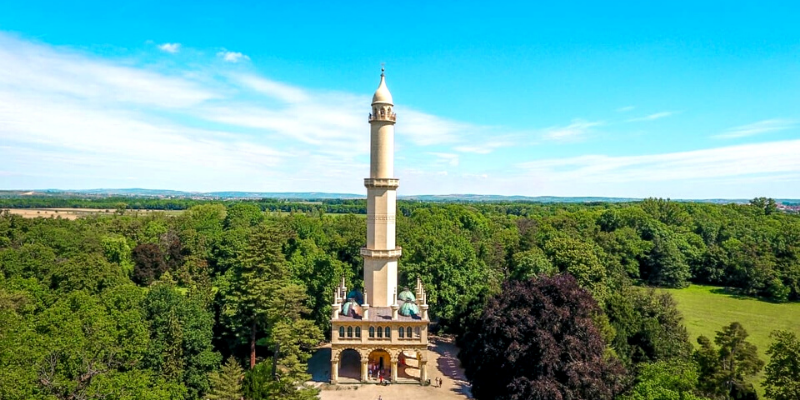
The Minaret or the ‘Turkish Tower’ is located on the grounds of the Lednice Castle Gardens. This attractive tower was built by Prince Alois Joseph I according to plans by architect Josef Hardtmuth – the famous pencil inventor and founder of the Czech firm Koh-i-noor, a major manufacturer of pencils and crayons. – at the turn of the 18th and 19th centuries. It is an exceptional construction of this character in Europe and stands almost 60 metres high – making it one of the tallest on the continent. However, we need to specify that it is not a religious building: it was built to give the park an exotic note, bringing the symbolic element of the Islamic culture to central Europe. The slender tower has three viewing platforms and serves as an unconventional lookout tower in the summer months; 302 stairs take you to the top. While the Minaret can be easily reached on foot through the chateau grounds, a cruise route also leads to it; boats depart from the jetty below Lednice Chateau. The lower part of the tower has eight rooms with ceilings, walls, and floors richly decorated with oriental ornaments. According to experts, this decorative work was carried out by artists from Arab countries....
From January 15, people of 80 years and older will be able to register themselves for COVID-19 vaccination, for the rest of the Czech population, it will open from February 1. Vaccination will be “voluntary and free” and it is planned for over 5.5 million people or 60-70% of the total Czech population of 10.7 million (according to June 2020 data from the Czech Statistical Office). The dates of vaccination will be distributed automatically – priority will be given to people with chronic diseases (for example, diabetes, obesity, lung or kidney disease). In the second phase, will be vaccinated government members, general practitioners, dentists, pharmacists, and state emergency services (firefighters, police, etc.). According to the forecast of the Ministry of Health, vaccination of the general public (stage three) should begin in May 2021. PM Babis said that shipments of vaccines from EU-approved manufacturers will arrive in the Czech Republic every Thursday during January. The Czech Republic reported 6,220 daily cases of COVID-19 for the past 24 hours, the Health Ministry said on Monday. There are 119,561 active cases currently, the highest since late October. The number of hospitalised patients is 5,777.
We are now very familiar with robots – machines that possess artificial intelligence and perform tasks that humans find arduous or simply unattractive. What you might not know is that the word robot comes from the Czech for “forced labour”. It was first used to mean an artificial humanoid in the stage play R.U.R. written in 1920 by Karel Čapek, which premiered on January 2, 1921, by the Unity of Klicper Theater Amateurs in Hradec Králové, and the official premiere was at the National Theater in Prague on January 25, 1921. The acronym stands for Rossumovi Univerzální Roboti and translates to English as Rossum’s Universal Robots. The title refers to the creations of Mr. Rossum, a Frankenstein-like inventor and possible inspiration for Metropolis’s Rotwang (who was himself an inspiration for Dr. Strangelove). Čapek told the London Saturday Review after the play premiered that Rossum was a “typical representative of the scientific materialism of the last [nineteenth] century,” with a “desire to create an artificial man—in the chemical and biological, not mechanical sense.” While others credit Karel Čapek, as the author of R.U.R., with coining the term, he insists it was in fact his older brother Josef, best known as a painter, but also noted as a writer and a...
On January 1st, 1993, Czechoslovakia split into the Czech Republic and Slovakia. A multi-ethnic nation born at the end of World War I in the glow of pan-Slavic brotherhood, Czechoslovakia survived dismemberment by the Nazis and more than four decades of Communist rule only to fall apart after just three years of democracy. Both countries divided their common “goods” (embassies, military equipment, etc.) on a two-to-one ratio to reflect their populations. The split “was not entirely inevitable, but the political and economic costs of keeping the country together would have been extremely high”, pointed out Jiri Pehe, political analyst and former advisor to Vaclav Havel. The split was cheered in Prague and Bratislava, by bonfires and joyous speeches in the main square. “Two states have been established,” Vladimir Meciar, Prime Minister of Slovakia, said at that time. “Living together in one state is over. Living together in two states continues.” Take a look at these photos and how Czechs and Slovaks celebrated the dissolution of the Czechoslovak Federal Republic (CSFR).
Czechs have long been the reigning world champions in beer consumption. Now it appears that pedigree has spread to teen use of alcohol… The European School Survey Project on Alcohol and Other Drugs (ESPAD) has found that 95% of 16-year-olds in the Czech Republic tried beer or hard liquor at least one time, compared to a European average of 79%. Nonetheless, asked if they had ever drunk alcohol, 82 percent of students said yes. This means Czech’s rates remain higher than the European average. When asked about alcohol consumption in the past 30 days, 79% of Czech students said they’d had a drink, well above the European average of 57%. Since the early 2000s, a continuous decline in alcohol use among adolescents from the Western European and Scandinavian countries was recorded. However, the widespread decrease was not equally present in all countries of Central and Eastern Europe. In the Czech Republic, a continuous increase in adolescent alcohol use between 1995 and 2011 was documented, with no signs for a decline. This increasing trend was apparent, particularly among the Czech adolescent girls. Data is collected every four years from 15- to 16-year-old students using an anonymous questionnaire. In 2019, just under...
Deaths on the road have plunged to the lowest point since 1961 thanks to reduced traffic during the coronavirus lockdown. Accidents have also fallen significantly. According to preliminary figures, there were 465 accident victims in 2020, compared to 547 in the same period last year. The number of accidents and serious injuries also decreased year-on-year. The final statistics will be presented at a press conference on 8 January. “We only saw an increase in the number of traffic fatalities in January and February. The coronavirus pandemic and associated lockdowns have led to far fewer cars on the roads. However, traffic increased significantly during the summer holidays, because people mostly spent holidays in the Czech Republic,” Traffic Police director Jiri Zly told CTK today. Total accidents fell to 93,300 — 14% fewer than 2020 while the number of seriously injured decreased by about a fifth to about 1,700. The police recorded alcohol in more than 4,400 traffic accidents, which is about 4% less than last year. Speeding and the lack of attention are the two main causes of traffic accidents in the Czech Republic and claim the highest number of fatalities. Moreover, a growing number of young drivers are involved. A fourth...
City Sightseeing is one of the world’s leading open-top bus, boat, and guided walking tour company. Established in 1999, the global brand provides hop-on hop-off services. City Sightseeing operates in over 100 locations across 5 continents which includes cities such as London, Rome, New York, Edinburgh, Seville, Moscow, Cape Town, and Prague. The lack of tourists in the Czech capital forced City Sightseeing Prague to file for insolvency. COVID-19 pandemic is mentioned by the company in the declaration of insolvency as the main reason for the current situation. “Due to the nature of the business, it is not possible to continue operating this type of activity, nor can we expect a change and possible improvement of the situation in the near future,” the company wrote in the proposal. According to the proposal, the company has liabilities in the amount of 14 million CZK. He mentions four buses, two of which are double-decker. According to the proposal, Unicredit Leasing, City Sightseeing Support (a British company, the Czech branch operates as a franchise) and the city of Prague are among the carrier’s largest creditors. In 2019, according to official documents, the company had sales of almost fifty million CZK, but the net...
Don’t have an account? Register
Already have an account? Log In
How Would You Like to Promote Your Business? PR ArticleDisplay bannersVideo productionNewsletter adsJob ListingsInfluencer Marketing
Your Email
We will come back to you within 24 hours with our proporsal